© Microhard Systems Inc. Confidential 37
3.0 Mesh Configuration
Secondary Coordinators are used to extend the coverage of the Primary Coordinator. More than one
Secondary Coordinator can be used for redundancy or to ensure adequate network coverage. A Secon-
dary Coordinator must be able to communicate with the Primary Coordinator and/or another Secondary
Coordinator to ensure proper synchronization to the units it services.
Although any and all units in a Mesh Network can be designated as a secondary coordinator, the num-
ber and placement of coordinators deployed should be taken into consideration. The reason for this is
that network synchronization is achieved by occasionally sending synchronization packets. The greater
the number of coordinators deployed, the more sync data that will be broadcast on the network, and the
higher the potential for collisions. During each Mesh Frame (or hop), a certain number of slots are set
aside for network synchronization data, allowing coordinators an opportunity to send their sync data.
Adding a large number of Secondary Coordinators may require changing the values for the both the
number of sync slots in a mesh frame and the interval at which Secondary Coordinators send sync data.
Increasing the number of sync slots gives more opportunity for sync data to be transmitted, but it adds
system latency as more time during each frame is spent on synchronization. Decreasing the interval that
synchronization packets are sent by each coordinator, results in it taking a long time for units to syn-
chronize with the network once they have been brought online. Ideally a balance between the two can
be found which minimizes the impact of the overall system performance. It should also be clear at this
point, that adding an excessive number of coordinators may not be the best design practice.
Secondary Coordinators are ideal candidates for being configured for routing. As they are generally
positioned to provide coverage for multiple units. More than 1 unit should be configured for routing.
Should one unit go offline, another with routing also enabled can continue to provide routing services.
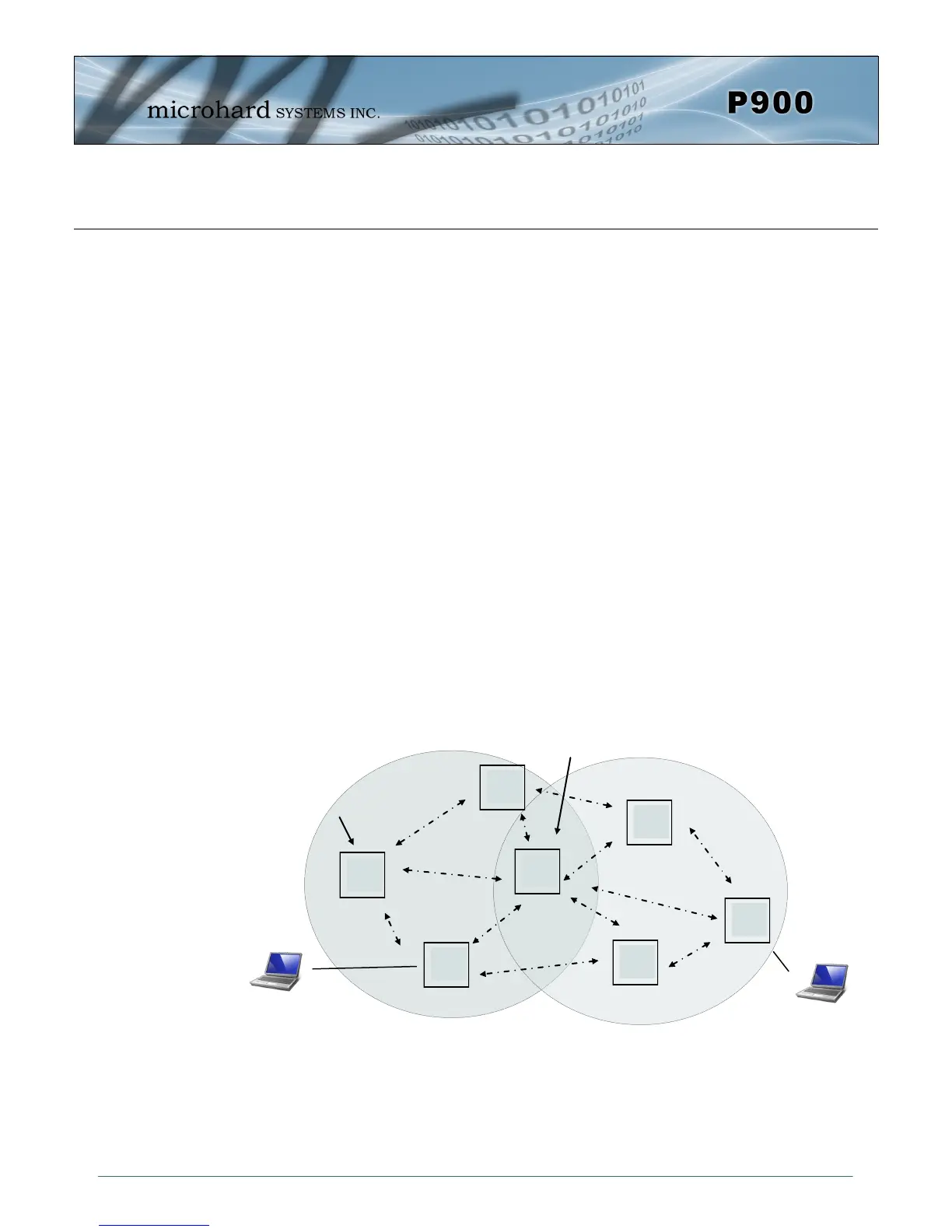
The following illustration shows the previous network coverage being extended by adding a secondary
coordinator.
Mesh
P.C.
Mesh
Mesh
S.C
Mesh
Mesh
Primary
Coordinator
Secondary
Coordinator
Drawing 3-3: Secondary Coordinator



 To Next Page