© Microhard Systems Inc. Confidential 74
5.0 Point to Multipoint Configuration
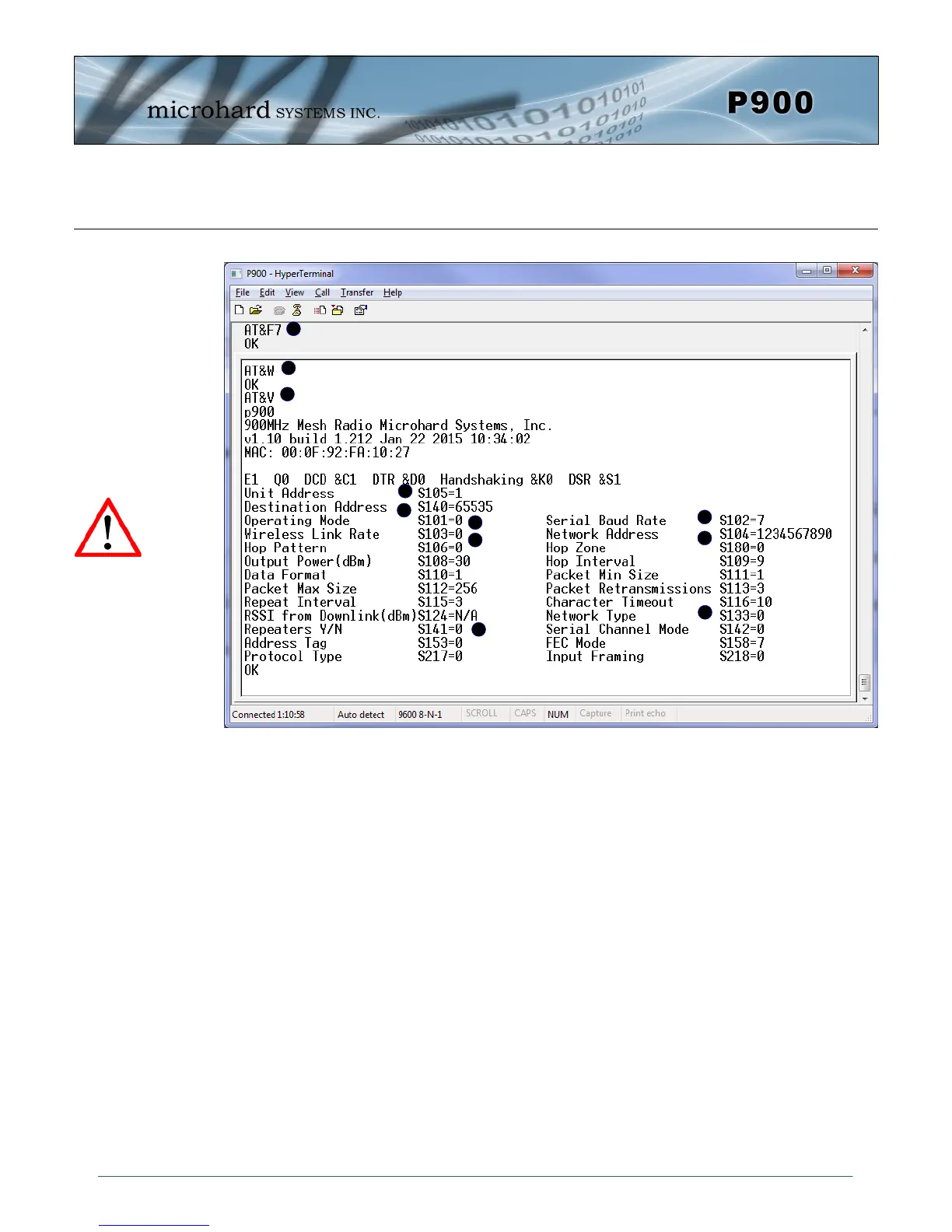
A) AT&F7 - Sets the factory defaults for a Point to Multipoint Master.
B) AT&W - Writes the changes to NVRAM.
C) AT&V - Displays the configuration as seen above.
D) S105 - Every unit in a Point to Multipoint Network must have a unique unit address. The Mas-
ter is automatically set to 1, and should not be changed.
E) S140 - The destination address for a PMP Network, by default is 65535, which means data is
broadcast from the Master to all other units.
F) S101 - The operating mode defines the unit type and is set to 0, which is a Master.
G) S103 - Wireless Link Rate must be set to the same value of each unit in the system.
Higher link rates may result in higher throughput, but lower link rates usually
provide better sensitivity and overall robustness.
H) S133 - The network type must be set to 0 for Point to Multipoint operation. The content dis-
played by the AT&V command will vary with the network type.
I) S102 - The serial baud rate (and data format S110) must match that of the connected device.
J) S104 - Each unit in a Network must have the same Network Address. It is strongly
recommended to never use the default setting of 1234567890. To change the
Network Address, the ATS104=XXXXXXX command can be used.
K) S141 - This register informs the master if 1 or more repeaters are present in the system. This
applies only to the master radio.
Remember, anytime registers are changed the values must be written to NVRAM using the AT&W com-
mand. To switch from command mode to data mode (online mode), the ATA command can be issued.
AT&F7 Point to Multipoint Master
A
B
C
G
D
E
F
Image 5-5: Factory Defaults AT&F7 - Point to Multipoint Master
H
I
J
K
Compression (S225)
was introduced in
firmware v1.10. S225
must be set to 0 for
compatibility with older
versions.


 To Next Page