© Microhard Systems Inc. Confidential 60
4.0 Point to Point Configuration
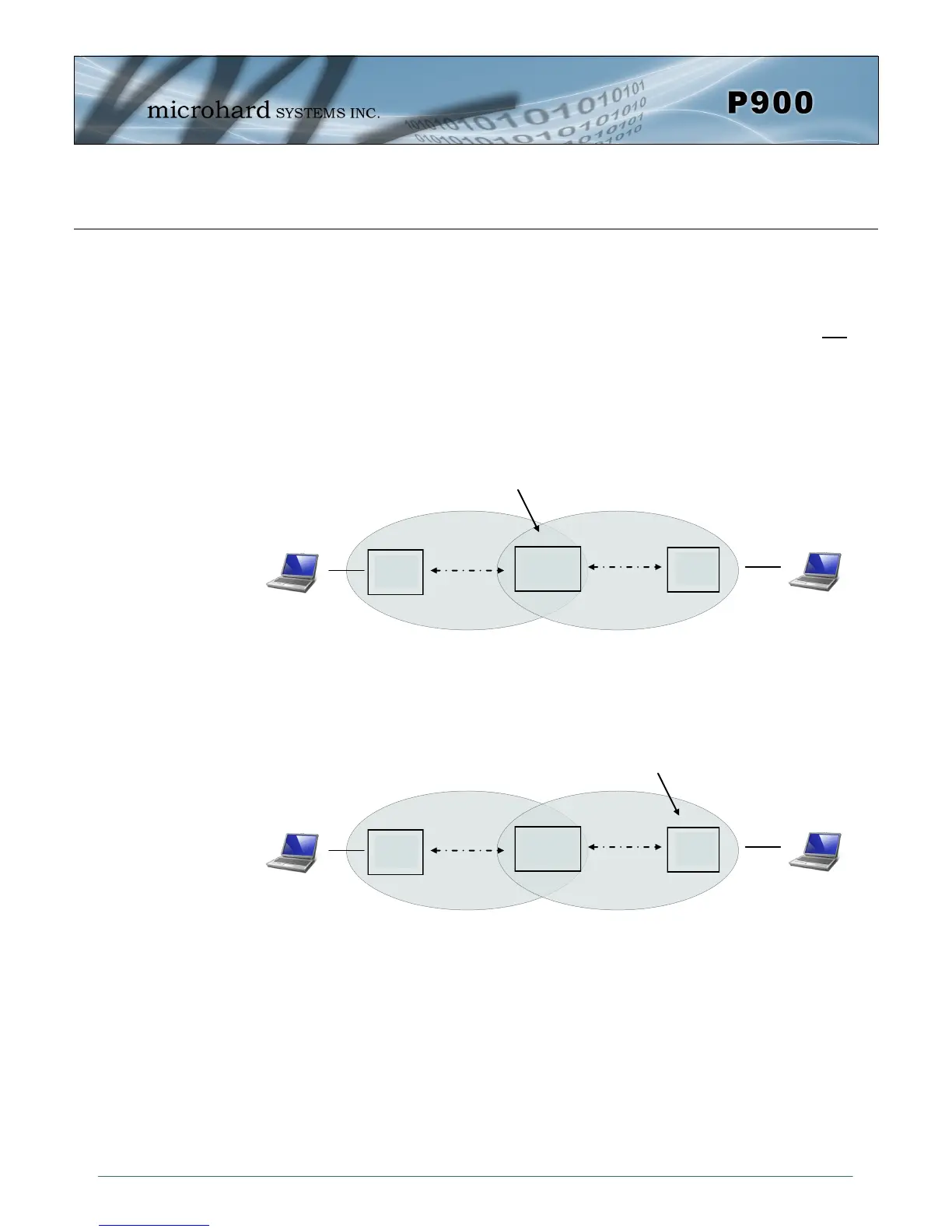
Repeaters can be used to extend the coverage of the Master. Required only if it is necessary to estab-
lish a radio path between a Master and Slave(s); stores and forwards data sent to it. Synchronizes to
Master and provides synchronization to ‘downstream’ units. If a local device is attached to a Repeater’s
serial data port, the Repeater will also behave as a Slave (aka Repeater/Slave).
Adding one or more Repeaters within a network will cut the overall throughput of the network in half; the
throughput is halved only once, i.e. it does not decrease with the addition of more Repeaters. If there is
a ‘path’ requirement to provide Repeater functionality, but throughput is critical, a work around is to
place two modems at the Repeater site in a ‘back-to-back’ configuration. One modem would be config-
ured as a Slave in the ‘upstream’ network; the other a Master (or Slave) in the ‘downstream’ network.
Local connection between the modems would be a ‘null modem’ cable. Each modem would require its
own antenna; careful consideration should be given with respect to antenna placement and modem
configuration.
A Slave (Remote) is an endpoint/node within a network to which a local device is attached. Communi-
cates with Master either directly or through one or more Repeaters.
Units can be configured to perform the various roles discussed by setting register S101 as follows:
ATS101 = 0 - Master
ATS101 = 1 - Repeater
ATS101 = 2 - Slave (Remote)
Drawing 4-3: Point to Point Repeater
Slave
Repeater
Master
Repeater
Slave
Slave
Master
Repeater
Drawing 4-4: Point to Point Slave



 To Next Page