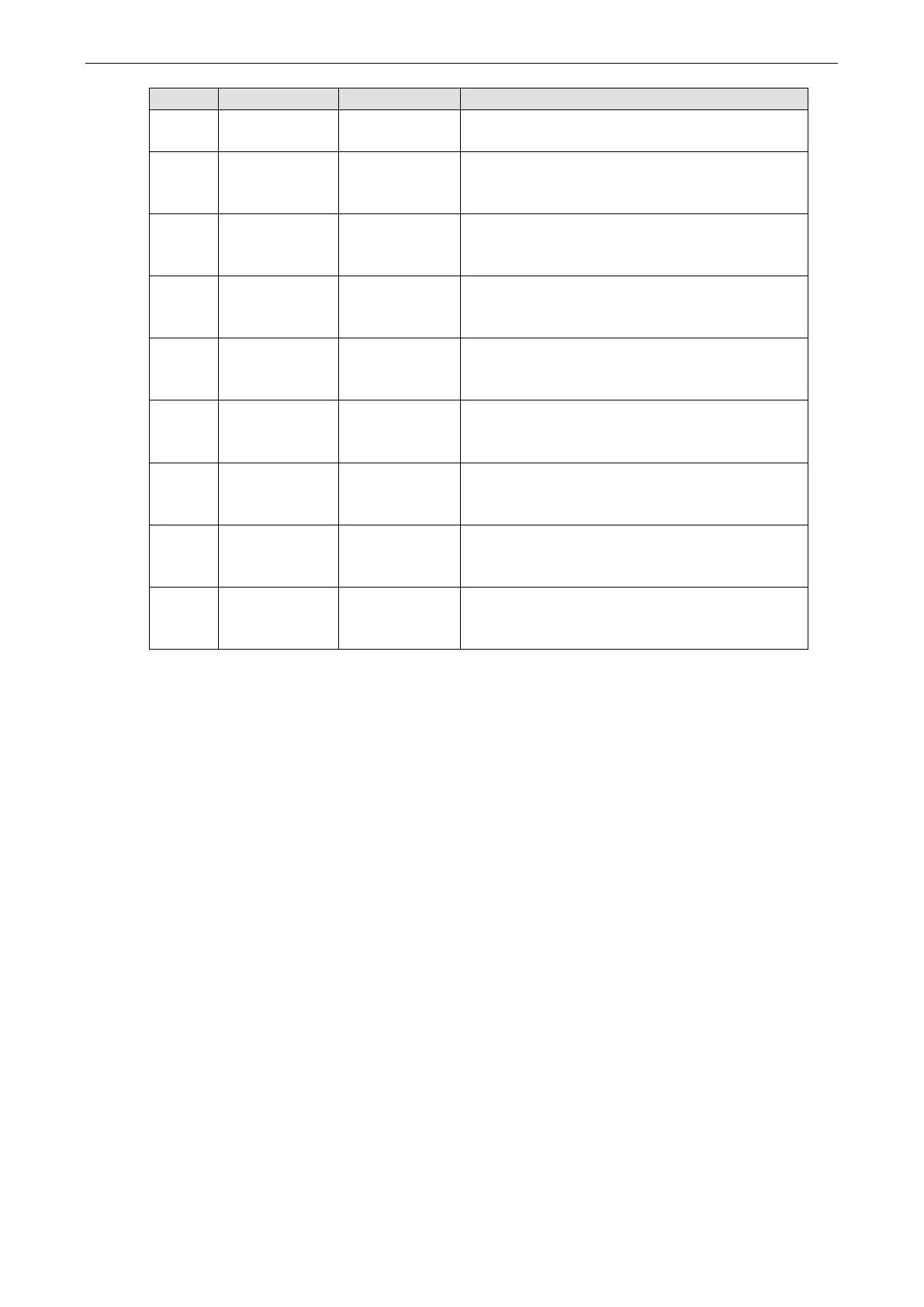
MiiNePort E2/E3 DIO Commands
Byte # Descriptor Value Description
4 Header 4, 6, 8 data length, depends on the number of DIO channels
requested
5 Data 0, 1 1st requested DIO channel, 0: channel has been
changed to input mode, 1: channel has been changed
to output mode
6 Data 0, 1
1st requested DIO channel, 0: channel status has been
changed to low, 1: channel status has been changed to
high
7 Data 0, 1 2nd requested DIO channel, 0: channel has been
changed to input mode, 1: channel has been changed
to output mode
8 Data 0, 1 2nd requested DIO channel, 0: channel status has
been changed to low, 1: channel status has been
changed to high
9 Data 0, 1 3rd requested DIO channel, optional, 0: channel has
been changed to input mode, 1: channel has been
changed to output mode
10 Data 0, 1
3rd requested DIO channel, optional, 0: channel status
has been changed to low, 1: channel status has been
11 Data 0, 1 4th requested DIO channel, optional, 0: channel has
been changed to input mode, 1: channel has been
changed to output mode
12 Data 0, 1
4th requested DIO channel, optional, 0: channel status
has been changed to low, 1: channel status has been
changed to high
For example, the eight-byte response 6-2-0-4-0-0-1-1 indicates that DIO 0 has been changed to input mode
and “low” status and DIO 1 has been changed to output mode and “high” status.
C Code Example
void WriteMultipleDIO(int start, int end, int* mode, int* status)
{
DIOPacketStruct packet;
packet.header.command = 6; // Write Multiple DIO Command Codes
packet.header.version = 2; // DIO protocol version
packet.header.length = (end-start+1)*2+2; // data length
packet.data[0] = start; // start DIO number
packet.data[1] = end; // end DIO number
int i, len;
for ( i=0; i<(end-start+1);i++ ) {
packet.data[i+2] = mode[i];
packet.data[i+3] = status[i];
}
send(SocketFd, )(char*)&packet,(end-start+1)*2+2+sizeof(DIOHeaderStruct), 0);
//Send TCP packet
//Process the returned data here
}


 To Next Page