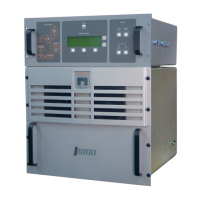
10 000 WATT FM BROADCAST TRANSMITTER
FM10
Page 2-2
01 October 2002
2.1.2 LIGHTNING PROTECTION:
Extremely high voltage/current transients are
produced when a lightning strike occurs. These
transients, which are probably the most significant
hazard to any solid state transmitter, may be passed
to the transmitter through the wiring connecting it to
its power source and its antenna system. It is
imperative that all practical precautions be taken to
protect the transmitter from this phenomenon. Refer
to the
Lightning Protection
section of Nautel’s
Recommendations for Transmitter Site Preparation
booklet for specific protection techniques. The
following requirements are considered to be essential.
2.1.2.1 Station Reference Ground: The site must
contain a station reference ground, as defined in the
Lightning Protection
section of Nautel’s
Recommendations for Transmitter Site Preparation
booklet. This ground must provide a continuous, low
impedance path to the earth. The transmitter
cabinet's designated reference ground point, the shield
of the coaxial feed cable and the ground connection
of the power source's surge protection devices must
be connected directly to the station reference ground.
2.1.2.2 AC Power Source: All conductors from
the AC power source should be protected by
bi-directional surge protection devices that are
connected between each conductor and the station
reference ground. A surge protector panel, that
contains suitably rated varistors is available from
Nautel for this purpose. If used, the surge protector
panel should be installed in close proximity to the
station reference ground.
NOTE
The AC power source usually presents the lowest
impedance path to ground potential and will
normally carry most of the lightning induced current
away from the transmitter site.
When lightning hits the power source, a significant
amount of induced current may flow towards the
transmitter. In this instance, the objective is to
route the current around the transmitter, instead of
through it, to the best ground available.
2.1.2.3 Antenna Feed Cable: The shield of the
antenna feed coaxial cable should be connected
directly to the station reference ground where it enters
the building. The centre conductor and the shield of
the feed cable should pass through a ferrite toroid
positioned between the shield ground at the building
entrance and the shield termination at the transmitter
reference ground. This toroid is transparent to the
RF signal, but will present impedance to transients
originating in the antenna.
2.1.2.4 Antenna Tower: The antenna tower is the
most likely target for lightning strikes. It is
imperative that it contain lightning protection devices
as the first line of defense against lightning strikes.
For towers which are grounded at their base, it is
recommended that a coaxial, gas-type spark gap be
installed where the coax enters the transmitter
building.
2.1.2.5 External Control/Monitor Wiring: All
external control/monitoring wiring, that may be
subjected to lightning induced transients, should be
interfaced to the station reference ground by surge
protection devices where they enter the building. In
addition, all conductors and their shields should pass
through a ferrite toroid which is positioned between
its surge protection device and the transmitter. This
toroid will be transparent to control/monitor signals,
but will present an impedance to lightning induced
transients.
2.1.3 ELECTRICAL POWER: The
transmitter is configured during manufacture to
operate from one of a variety of 50/60Hz three phase
ac power sources. The option selected is specified by
the purchaser. Refer to table 1-1 for an itemized
listing of standard voltage options. The AC power
source must meet all of the following requirements:
2.1.3.1 Nominal Voltage: The primary winding
of the main AC power transformer contains tap
options to accommodate voltages that differ from the
ideal voltage of the power source. There are five tap
options on the three-phase power transformers (5%
increments). The appropriate tap is selected during
installation to provide the optimum nominal voltage
for the transmitter.
2.1.3.2 Voltage Stability: The AC power source's
nominal voltage must be stable to within plus and
minus ten percent under all loading conditions. The
transmitter contains circuitry that maintains the RF
output at the preset carrier level for voltage
variations within this range.


 To Next Page