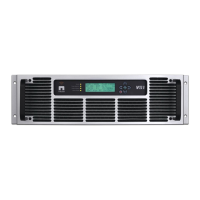
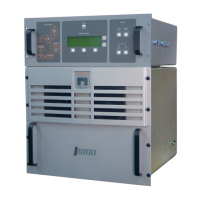
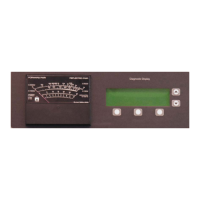
10 000 WATT FM BROADCAST TRANSMITTER
FM10
Page 5-20
01 October 2002
NOTE
Following each trouble shooting action taken on the
MODULE RF DRIVE alarm, press MODULE RESET
and ALARM RESET switches. If three or more RF
power modules have been inhibited, it will also be
necessary to press/release the PROTECT RESET
switch. If the MODULE RF DRIVE alarm(s) cannot be
reset, the fault remains and trouble shooting should
continue. If transmitter operation is restored to the
desired power level, the fault has been cleared.
(a) Note which PA VDC - PWR SPLY lamp(s) (
A
thru F) has turned on. The transmitter output
power should have been reduced (or inhibited -
depending on the number of failures).
(b) A sample of each RF power module's
intermediate RF drive level is applied to J5-7
thru J5-12 (RF power module A thru F
respectively) of the control/monitor PWB
(A14). Measure the voltage between the
associated J5 pin(s) on the control/monitor
PWB and ground.
(c) If one or more of the digital multimeter readings
are not near the voltages recorded as
Intermediate RF Level (A thru F)
in table 5-6,
check the appropriate cables and connectors
between the intermediate RF drive splitter
(A15) and the associated RF power module's
input.
(d) If the cables and connectors from step (c) are
operational, a problem may exist within the
associated RF power module's power module
interface PWB. Refer to the RF power
module's service instruction manual.
(e) If the multimeter readings from step (b) are
near the level determined in step (c), the
control/monitor PWB's intermediate RF level
monitor circuitry may be defective.
NOTE
If it is necessary to check the control/monitorPWB's
intermediate RF level monitor circuitry, refer to the
control/monitor PWB's service instruction manual
and the trouble shooting data in section 7 of this
manual to isolate circuit defects.
5.11.3 MODULE TEMP ALARM: A
MODULE TEMP alarm can occur if the
temperature sensed within an RF power module
exceeds 85
°
C due to a failed RF power module fan or
a blockage in the RF power module's normal air flow.
The associated switching power supply will also be
inhibited, and therefore, a PA VDC FAIL - PWR SPLY
alarm (A thru F) will also occur, as well as a
reduction in RF output power. If this affects three or
more RF power modules, a COMBINER MATCHING
alarm should also occur and the transmitter will be
inhibited. Trouble shoot a module temperature alarm
as follows:
NOTE
Following each trouble shooting action taken on the
MODULE TEMP alarm, press MODULE RESET and
ALARM RESET switches. If three or more RF
POWER MODULES have been inhibited, it will also
be necessary to press the PROTECT RESET switch.
If the MODULE TEMP ALARM(s) cannot be reset, the
fault remains and trouble shooting should continue.
If transmitter operation is restored to the desired
power level, the fault has been cleared.
(a) Note which PA VDC - PWR SPLY lamps (A thru
F) has turned on. The transmitter output power
should have been reduced (or inhibited -
depending on the number of failures). It is
probable an excessively high temperature
occurred in an RF power module.
Ensure a module has had sufficient time to cool off
before proceeding.
(b) Check fan fuses F3 thru F5 on the low voltage
power supply PWB (A26A1) by measuring the
voltage across them. An open fuse will cause
two RF power module fans to turn off. If a
fuse has become open circuit, replace it and
monitor for recurrence.


 To Next Page