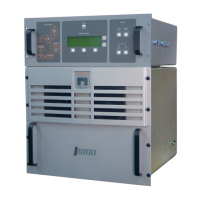
10 000 WATT FM BROADCAST TRANSMITTER
FM10
Page 5-8
01 October 2002
5.7.2.1 Test Equipment For Tuning: The
following test equipment is required to tune input/
output power amplifiers:
(a) One power amplifier tuning kit which contains:
- Tuning shelf, complete with attached tuning
attenuator.
- B+ extender cable - Nautel part number 182-
5020.
- Control/monitor extender cable - Nautel part
number 161-5017.
- RF drive extender coaxial cable - Nautel part
number 182-5035.
(b) A model 43 Bird thruline wattmeter that has its
RF power probe separated from its chassis, has
an adapter that terminates the probe's output
with a BNC coaxial connector, has a 25W
element installed and has a 1.0W element
available.
NOTE
The power probe's coaxial connector must connect
directly to the RF power module interface PWB's
PA
TUNE BNC connector, using a suitable adapter. If
the probe has a type 'N' output connector, it will be
necessary to obtain an N plug to BNC plug adapter
(UG1034/U). Use of a coaxial cable may cause an
impedance mismatch.
(c) A model 43 Bird thruline wattmeter that has a
500W element installed in it.
(d) A 50-ohm, 300W (minimum) dummy load with
a VSWR of 1:1 (88MHz - 108MHz).
(e) An RF coaxial cable that is sufficiently long to
connect the thruline wattmeter to the dummy
load must be obtained. An RG303 coaxial
cable, terminated by coaxial connectors that
will mate with the connectors on the wattmeter
and dummy load, must be used.
(f) Two additional RG303 RF coaxial cables must
be obtained:
- One to interconnect the output of the RF
amplifier being tested to the input of the
thruline wattmeter which is connected to the
dummy load, and
- One to interconnect output of tuning shelf's
tuning attenuator and the input of the RF power
probe connected to RF power module interface
PWB's PA TUNE BNC connector.
NOTE
If a wattmeter's input will accept a BNC connector,
one of the six coaxial cables that originally
interconnected the RF combiner and the removed
RF power module's output connectors, can be used.
If not, an RG303 coaxial cable that is terminated at
one end by a BNC connector and at the other end by
a coaxial connector that will mate with the
wattmeter's input connector must be obtained.
5.7.2.2 Preparation for Tuning: Fasten the tuning
shelf to the rear of the transmitter and interconnect
the RF power module, containing input/output power
amplifiers to be tuned, to the transmitter and the test
equipment as follows:
(a) Set or verify the PWR MDL circuit breaker
(located on the circuit breaker panel) associated
with all removed RF power modules is set to
OFF (toggle down).
(b) Attach the tuning shelf to the back of the
transmitter as depicted in figure 5-2.
(c) Position the RF power module to be tuned on
the tuning shelf, with its top side facing
upwards.
(d) With the exception of the PA volts extender
cable (P/N 182-5020), connect the RF power
module as depicted in figure 5-1, noting:
NOTE
PA volts for the RF power module to be tuned is
supplied from an operational RF power module ('E'
or 'F'), by the PA volts extender cable. Do not
install the cable until directed to do so.


 To Next Page