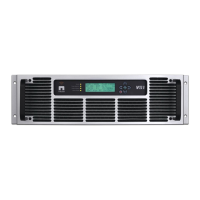
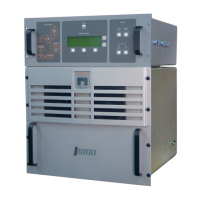
10 000 WATT FM BROADCAST TRANSMITTER
FM10
Page 5-26
01 October 2002
NOTE
If one of the six-way splitter's cables has open or
short circuited, the associated RF power module's
switching power supply will be inhibited due to low
RF drive input level and the MODULE RF DRIVE and
associated PA VDC FAIL PWR SPLY lamp shall be
on.
(c) If the transmitter has not been latched off,
verify the voltage on U33-7 of the control/
monitor PWB is near that recorded as
IPA
Refld Pwr Level
in table 5-6.
5.11.10.2 IPA Forward Power: Determine whether
an excessive IPA forward power level caused the
alarm as follows:
(a) If the IPA SWR alarm is on and the transmitter
has not been latched off, check cables between
the IPA combiner/splitter probe's output and
the RF power module inputs.
(b) If the IPA SWR alarm is on and the transmitter
has been latched off, check for an open or short
circuit on the cables between the six-way
combiner splitter and the RF power module
inputs.
NOTE
If one of the six-way combiner/splitter cables has
open or short circuited, the associated RF power
module's switching power supply will be inhibited
due to low RF drive input and the MODULE RF
DRIVE lamp and associated PA VDC FAIL PWR SPLY
lamp shall be on.
(c) If the cables in steps (a) and (b) are not short
circuited and the transmitter is still latched off,
check the low voltage power supply PWB as
detailed in this instruction manual.
5.11.11 IPA TEMP ALARM: An IPA TEMP alarm
can occur if the temperature sensed within the IPA
module exceeds 73
°
C due to a failed IPA module fan
or a blockage in the normal air flow. The
transmitter's RF output should not be affected by this
alarm, nor should the IPA switching power supply be
inhibited or tripped off by its associated PWR MDL
circuit breaker. Trouble shoot an IPA temperature
alarm as follows:
NOTE
Following each trouble shooting action taken on the
IPA TEMP alarm, press the ALARM RESET switch. If
the alarm lamp turns off, the fault has been cleared.
If the alarm lamp remains on, trouble shooting
should continue.
(a) Check fan fuse F2 on the low voltage power
supply PWB (A26A1) by measuring the voltage
across it. An open fuse will cause the IPA module's
fan to turn off. If a fuse has become open circuit,
replace it and monitor for recurrence.
Since the IPA is not inhibited during an
IPA TEMP
alarm, the temperature of the IPA module may be
in excess of 73
°°
C. Use extreme care when
inspecting its air path and cooling fan.
(b) Perform a visual inspection of the IPA module
for fan blockage. Check for air flow out of the
front of the module. If a blockage exists, it will
be necessary to remove the IPA module and
clean the obstructed air path or replace the fan,
as required. Verify 24 VDC is on P4-1
(normally mates with J4 of the IPA module) to
isolate a possible wiring defect.
NOTE
The IPA module may be temporarily replaced by an
RF power module while the IPA module is being
serviced. Refer to paragraph 5.8 to replace the IPA
module with an operational RF power module.
(c) Once the IPA module has been removed,
measure the resistance of temperature sensing
thermistor RT1, located on top of the module.
If the IPA module has sufficiently cooled
(25
°
C), the resistance should be near 200K
ohms.
(d) If the resistance measured in step (c) is near the
value specified, the control/monitor PWB's IPA
module temperature circuitry may be defective.


 To Next Page