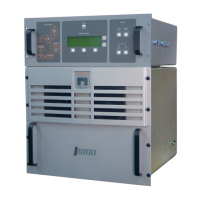
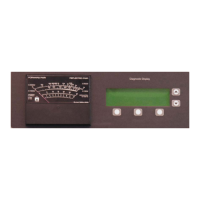
10 000 WATT FM BROADCAST TRANSMITTER
FM10
Page 2-6
01 October 2002
2.1.10.4 AC Power Alarm: The AC Alarm output
is applied to the AC PWR ALARM terminal TB2-4 of
the control/monitor PWB (A14). During normal
operation, the output is an open collector. When the
AC power source voltage goes more than 15% above
or 15% below the ideal voltage for the power
transformer's selected primary winding taps, or one
of the three AC input phases is lost, the AC PWR
ALARM
output will switch to a current-sink-to-
ground. The RF output will be inhibited.
2.1.10.5 High Temperature Alarm: The High
Temp Alarm output is applied to the HIGH TEMP
ALARM
terminal TB2-5 of the control/monitor PWB
(A14). During normal operation, the output is an
open collector. When sensors detect excessive
temperature in an RF power module, IPA module or
power supply rectifier, the HIGH TEMP ALARM
output will switch to a current-sink-to-ground. The
following will cause a High Temp Alarm.
- Temperature of either three-phase rectifier
assembly exceeds 90
°
C. The transmitter's RF
output will be inhibited.
- Temperature in the IPA module exceeds 73
°
C.
The RF output will not be affected.
- Temperature in an RF power amplifier module
exceeds 85
°
C. The affected module will be
switched off, reducing the RF output.
2.1.10.6 PA Volts/Combiner Alarm: The PA
Volts/Combiner Alarm output is applied to the PA
VDC/CMBR ALARM terminal TB2-6 of the control/
monitor PWB (A14). During normal operation, the
output is an open collector. When the PA voltage
applied from the switching power supplies to the RF
power modules exceeds 55 VDC or the forward
power is too low for the level of PA voltage applied
to the RF power modules, the PA VDC/CMBR ALARM
output switches to a current-sink-to-ground. The RF
output is inhibited. Other alarm conditions which
cause a switching power supply to be inhibited, such
as excessive switching power supply temperature or
low PA volts, will activate the PA Volts/Combiner
alarm.
2.1.10.7 Interlock Open Alarm: The Interlock
Open Alarm output is applied to INTLK OPEN
ALARM
terminal TB2-7 of the control/monitor PWB
(A14). When the interlock circuit is intact (short
circuit) the output is an open collector. When the
interlock is open the
INTLK OPEN ALARM
output
switches to a current-sink-to-ground. The RF output
will be inhibited.
2.1.10.8 Fan Fail Alarm: The Fan Fail Alarm
output is applied to FAN FAIL ALARM
terminal TB2-8
of the control/monitor PWB (A14). When the four
fans located in the power supply compartment and
the two fans on the lower, rear panel are functioning
normally, the output is an open collector. If one or
more of the fans should fail, the Fan Fail Alarm
output switches to a current-sink-to-ground. The RF
output will not be affected.
2.1.10.9 Low Battery Alarm: The Low Battery
Alarm output is applied to LOW BATTERY ALARM
terminal TB2-17 of the control/monitor PWB (A14).
When the backup battery voltage drops below 4.2V,
the Low Battery Alarm output switches to a current
sink-to-ground. The RF output is not affected. The
Low Battery Alarm output is an open collector when
the battery voltage is acceptable.
2.1.11 REMOTE STATUS INDICATIONS:
External monitoring outputs that indicate the status
of operator controlled circuits are available at
terminals of TB2 on the control/monitor PWB (A14).
All status outputs, except REMOTE STATUS, employ
a Darlington transistor. Each output provides an
open collector when inactive and a current-sink-to-
ground when active. Each external monitoring circuit
must present an impedance, between the transistor
and a positive DC voltage source, that will result in a
current flow of 40mA or less. The voltage source
must not exceed 28V. Each output is protected
against transients and/or over voltage by a 33 volt
zener diode.
2.1.11.1 Remote Status: The Remote Status
output is applied to REMOTE STATUS terminal
TB2-11 of the control/monitor PWB (A14). When
the control/monitor panel's CONTROL switch is set to
LOCAL, this output is an open circuit (open relay
contacts) and the remote control functions have no
influence on the transmitter's on/off status or the
protection/alarm reset functions. When the
CONTROL switch is set to REMOTE
,
the REMOTE
STATUS output is a connected to ground. The
transmitter's on/off status and the protection/alarm
reset functions can be controlled remotely.


 To Next Page