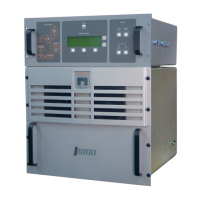
10 000 WATT FM BROADCAST TRANSMITTER
FM10
Page 2-14
01 October 2002
NOTE
A set of relay contacts are connected to TB1-15
(COM), TB1-13 (N/O) and TB1-14 (N/C) as the
exciter interlock control. The relay status
identification on TB1-13 and TB1-14 does not
reflect the energized/de-energized state of the relay,
it represents the relay state when the exciter's RF
output is not to be muted.
- When an open circuit is required for normal
operation and a contact closure is required to
mute the exciter's RF output, connect the
exciter interlock conductor to TB1-13 (N/O)
and its shield to TB1-15 (COM).
-
When an contact closure is required for normal
operation and an open circuit is required to
mute the exciter's RF output, connect the
exciter interlock conductor to TB1-14 (N/C)
and its shield to TB1-15 (COM).
(c)
Reinstall the transmitter’s upper, rear panel,
ensuring the safety ground wire is reconnected.
2.2.9 RF OUTPUT ACCESS: Remove the
protective cover from the EIA flange connection on
the top of the cabinet (RF output) and the dowel from
its inner connector as follows:
(a) Remove the four 1/4-20 hex nuts securing the
EIA flange connection's aluminum shipping
cover. Retain hardware.
(b) Carefully withdraw aluminum shipping cover,
noting it contains a dowel that is inserted in the
EIA inner connector. Discard shipping cover.
(c) Obtain output plate assembly (P/N 182-6031)
included in the shipment.
(d) Using the hardware retained from step (a),
install the output plate assembly on the top of
the RF output, noting that the studs of the
assembly are to point upwards (refer to figure
MD-11). Tighten hardware securely.
2.2.10 INSTALLATION OF RF FEED
CABLE: Connect an RF feed coaxial cable, that has
been cut to the required length, to the transmitter's
RF output; noting the RF feed cable termination point
is located at the top of the RF output filter (refer to
figure MD-15 for location and dimensional
information).
NOTE
The transmitter's RF output should be applied to a
dummy load during the commissioning procedure's
initial turn-on. If the RF feed cable is not connected
to a switching circuit that permits antenna/dummy
load selection, ensure the RF feed cable for the
dummy load is connected to the transmitter's RF
output connection until otherwise specified during
the commissioning procedures.
2.2.10.1 Connection of RF Feed Cable: Connect
the RF feed cable to the transmitter's RF output
(3 1/8 EIA inch flange) connection as follows:
(a) Verify the RF feed cable is in place and has
been cut to the required length.
(b) Install a 3 1/8-inch EIA flange connector on the
feed cable.
NOTE
If the RF feed cable's EIA flange connector does not
have a male connector for the centre conductor, an
EIA bullet for a 3 1/8 inch EIA flange connector
must be obtained.
(c) Locate and remove four 3/8 nuts and three 3/8-
inch washers from the EIA flange connector
mounting studs on the top of the RF power
probe.
(d) Carefully install the RF feed cable's 3 1/8 inch
EIA flange connector on the RF power probe's
flange mounting studs. Ensure its bullet mates
with the rigidly mounted cup connector on the
RF power probe. Secure using attaching
hardware removed in step (c). Ensure nuts are
firmly tightened.
2.2.11 REFERENCE GROUND INTER-
CONNECTION: Connect a continuous, low-
impedance conductor (0 AWG copper wire, two-inch
copper strap or equivalent), as described in Nautel's
'Lightning Protection for Radio Transmitter Stations'
booklet, between the station reference ground and the
insulated reference ground stud at the bottom rear of
the cabinet.


 To Next Page