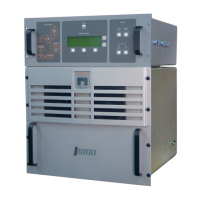
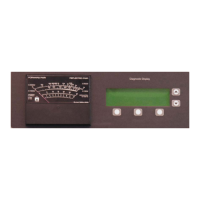
10 000 WATT FM BROADCAST TRANSMITTER
FM10
Page 5-2
01 October 2002
5.3.1.2 Local Trouble Shooting: Local on-air
trouble shooting consists of monitoring the
transmitter's integral meters and fault alarm
indicators. Analysis of their status will normally
identify the type of fault and in most cases will
determine what corrective action must be taken.
Refer to paragraph 5.11 and table 5-5 to determine
the remedial action required for a given fault.
5.3.1.2.1 The power amplifier stage contains an
integral modular reserve (IMR) feature. This feature
permits the transmitter to operate at a reduced RF
output level when a malfunction occurs in one of its
RF power amplifier modules. Station operating
procedures will dictate if the reduced RF output level
is acceptable. When the reduced RF output level can
be tolerated, replacement of the defective RF power
amplifier module may be deferred to a more
convenient time. A defective module may be
removed from the transmitter for servicing, while the
transmitter is operating at a reduced RF output level,
provided the removal instructions detailed in
paragraph 5.7.1 are met. Refer to paragraph 5.7 for
RF power amplifier module removal/replacement
instructions.
If the transmitter is operated with an RF power
amplifier module removed, the appropriate
PWR
MDL
circuit breaker (located on the circuit breaker
panel) must be set to
OFF
(down).
5.3.2 OFF-AIR TROUBLE SHOOTING:
Off-air trouble shooting must be performed when
replacement of a defective RF power amplifier
module or routine on-air calibration adjustments will
not restore operation. It is recommended the output
be connected to a precision 50-ohm resistive dummy
load (rated at a minimum of 15kW) for off-air
trouble shooting procedures. If an appropriate
dummy load is not available, trouble shooting for a
majority of faults can be performed with the power
amplifier stage turned off. The transmitter may
remain connected to its antenna system for these
procedures. It is recommended the RF output level
be reduced to a minimal value when the RF output is
connected to the antenna system and it is necessary to
trouble shoot faults in the power amplifier stage.
5.3.2.1 When the intermediate power amplifier
(IPA) module is defective and a serviceable
replacement is not available, it can be replaced by an
operational RF power amplifier module. The
transmitter is off-air during module replacement.
Refer to paragraph 5.8 for IPA module/RF power
amplifier module replacement instructions.
ELECTROSTATIC PROTECTION
5.4
The transmitter's assemblies contain
semiconductor devices that are susceptible to damage
from electrostatic discharge. Prior to removing an
assembly from the transmitter, and while servicing an
assembly, the following precautions must be
observed:
NOTE
Electrostatic energy is produced when two
insulating materials are rubbed together. A person
wearing rubber-soled shoes, walking across a nylon
carpet or a waxed floor, can generate an extremely
large electrostatic charge. This effect is magnified
during periods of low humidity. Components such
as integrated circuits, field-effect transistors,
thyristors, and Schottky diodes may be damaged by
this high voltage unless adequate precautions are
taken.
5.4.1 PERSONAL DISCHARGING:
Maintainers should be electrically discharged by a
suitable grounding system (anti-static mats,
grounding straps) during removal of an assembly
from the transmitter and while handling the assembly
for maintenance procedures.
5.4.2 HANDLING/STORAGE: The assembly
should be placed in an anti-static bag when it is not
installed in a host transmitter or when it is not being
subjected to maintenance procedures. Electronic
components should be stored in anti-static materials.
5.4.3 TOOLS/TEST EQUIPMENT: Testing
and maintenance equipment, including soldering and
unsoldering tools, should be suitable for contact with
static sensitive semiconductor devices.


 To Next Page