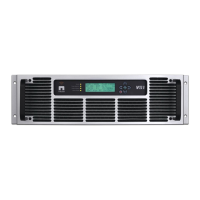
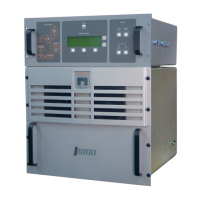
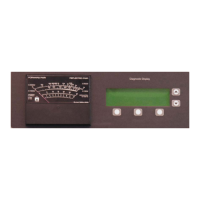
10 000 WATT FM BROADCAST TRANSMITTER
FM10
Page 5-23
01 October 2002
- At least four transient SWR conditions, in
excess of 2:1 (1220 watts), were detected
within a five second time interval indicating
arcing or lightning strikes.
- A continually degrading match has caused a
reduction in the transmitter's forward power to
maintain operation. The severity of the
mismatch has reduced the forward power below
1500 watts and the transmitter cannot operate
reliably.
(a) Verify the cause of the mismatch and/or
transient SWR condition has been removed.
Press the control/monitor panel's PROTECT
RESET
switch. If the cause of the alarm has
been cleared, the transmitter should resume
operation. Press ALARM RESET.
5.11.7.2 Reflected Power Zero Watts and
Forward Power Normal: If the REFLECTED
POWER
indication is near zero watts and the
FORWARD POWER
indication reads the normal
operating power level:
- a 2:1 SWR transient has probably occurred due
to an arc or lightning, but not frequently enough
to cause a shutdown. Press ALARM RESET.
(a) If the problem persists and there is no evidence
of lightning, suspect arcing or another transient
fault within the antenna system. If no arcing or
other intermittent antenna system faults can be
found, a problem may exist with the
control/monitor PWB's reflected power
detection circuitry.
NOTE
If it is necessary to check the control/monitor PWB's
reflected power detection circuitry, refer to the
control/monitor PWB’s service instruction manual
to isolate circuit defects.
5.11.7.3 Reflected Power Between 100 and 440
Watts: If the REFLECTED POWER indication is
between 100 and 440 watts, excessive SWR may
exist at the transmitter output.
(a) If an external reflected power meter is
available, verify its reading is similar to that on
the control/monitor panel.
(b) If the external reflected power meter's reading
is near zero watts, a problem may exist with the
control/monitor PWB's reflected power
detection circuitry.
(c) If the FORWARD POWER indication is near the
normal operating level and no reflected power
cutbacks have occurred, the reflected power
level has not exceeded the cutback threshold of
440 watts.
NOTE
When the reflected power exceeds 100 watts, the
transmitter's ALC (automatic level control) circuit is
disabled. This may account for some variation in
the forward power level.
(d) If the forward power has been reduced, it is
probable the RF load impedance is not
optimum (50-ohms) and the reflected power has
exceeded 440 watts (but not 1220 watts). The
forward power will have been cutback
(reduced), by an incremental forward power
reduction protection circuit, to maintain the
reflected power at less than 440 watts. The
degree of RF load impedance mismatch
determines the number of increments (up to 32)
that are required to ensure the reflected power
does not exceed 440 watts. If the forward
power is reduced to a nominal 1500 watts and
the reflected power is still in excess of 440
watts, the RF output will shutback (turn off)
and remained latched in this state until the
protection circuits are manually reset (locally or
remotely as appropriate).
(e) Perform a visual inspection around the
transmitter output (including antenna). If there
is an obvious reason for the mismatch, attempt
to correct it.
NOTE
Fault causes at the transmitter's RF output may
include antenna icing, intermittent or defective feed
cable/RF connections or a defective antenna.
Random alarms may be caused by arcing of the RF
feed cable or lightning discharges.


 To Next Page