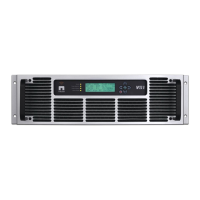
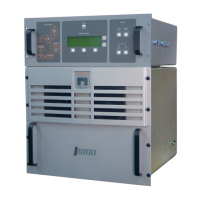
10 000 WATT FM BROADCAST TRANSMITTER
FM10
Page 5-28
01 October 2002
(f) Since the circuit breaker could not be reset, it is
probable that the alarm was triggered due to an
excessively high output from the associated
power supply module. Refer to the switching
power supply module's service instruction
manual for replacement or repair instructions.
(g) If, after replacing/repairing the faulty switching
power supply module, the alarm continues to
occur, refer to the power supply control PWB
service instruction manual for replacement or
repair.
5.11.13 PWR SPLY FAIL IPA ALARM: A
PWR SPLY FAIL IPA alarm can occur if the output
voltage of the IPA switching power supply is/was in
excess of 51 VDC or the output voltage of the IPA
switching power supply is/was too low for the control
voltage level being applied to its control circuit.
Trouble shoot a PWR SPLY FAIL IPA alarm as
follows:
(a) If the circuit breaker for the IPA switching
power supply has not tripped off, it is probable
the alarm was triggered due to a low output
from the supply or the allowable operating
temperature was exceeded. Refer to paragraph
5.11.13.1 to trouble shoot these failure
conditions.
(b) If the circuit breaker for the IPA switching
power supply has tripped off, it is probable the
alarm was triggered due to an excessive output
from the IPA supply. Refer to paragraph
5.11.13.2 to trouble shoot this failure condition.
5.11.13.1 Low IPA Supply Output: Trouble
shoot the IPA switching power supply module for a
low output by checking the following:
(a) Using a digital voltmeter, measure the output
voltage of the IPA supply at the test point
(TP1) provided on the supply.
(b) Compare the reading obtained in step (a) with
the voltage recorded as
IPA VDC
in table 5-6.
If these readings do not coincide, refer to the
switching power supply modules service
instruction manual for replacement or repair
instructions.
(c) Allow the system to run to see if the alarm
reoccurs. If the alarm reoccurs, refer to the
switching power supply module's service
instruction manual for replacement or repair
instructions.
(d) If, after replacing/repairing the IPA switching
power supply module, the alarm continues to
occur, a possible defect exists in the power
supply control PWB's low IPA volts detection
circuitry.
NOTE
If it is necessary to check the power supply control
PWB's low IPA volts detection circuitry, refer to the
power supply control PWB's service instruction
manual and the trouble shooting data in section 7 of
this manual to isolate circuit defects.
5.11.13.2 High IPA Supply Output: Trouble
shoot the IPA switching power supply module for a
high output by checking the following:
(a) Attempt to reset the associated switching power
supply's circuit breaker.
(b) If the circuit breaker cannot be reset, it is
probable that the alarm was triggered due to an
excessively high output from the IPA power
supply module. Refer to the switching power
supply module's service instruction manual for
replacement or repair instructions.
(c) If, after replacing/repairing the IPA switching
power supply, the alarm continues to occur,
refer to the power supply control PWB service
instruction manual for replacement or repair.
5.11.14 FAN FAIL ALARM: A fan fail alarm
can occur due to the failure of one or more of the DC
fans located in the fan assemblies (A27 and A28) or
on the rear, lower panel. A pulse train, representative
of each fan's speed, is monitored by the power supply
control PWB's fan monitor circuitry. If one or more
of these fans stall or fail, a local and remote FAN
FAIL alarm will be generated. Trouble shoot a fan
fail alarm as follows:


 To Next Page