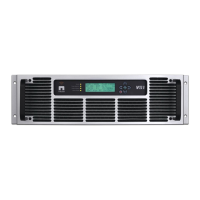
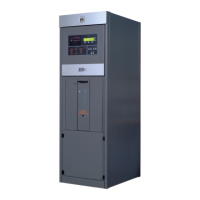
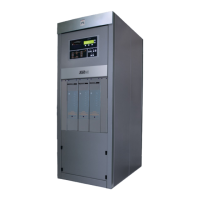
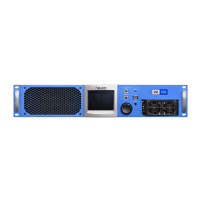
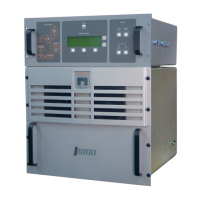
10 000 WATT FM BROADCAST TRANSMITTER
FM10
Page 4-2
01 October 2002
TURNING ON THE TRANSMITTER
4.5
Turn on the transmitter as described in
paragraph 4.10 for initial startup and after repairs
that may have affected the tuning of frequency
sensitive circuits.
POWER AMPLIFIER MODULE CIRCUIT
BREAKER SETTINGS
4.6
Each of the six RF power amplifier
modules has an associated PA switching power
supply and a circuit breaker (POWER SUPPLY
CONTROL - PWR MDL). They are located on the
circuit breaker panel.
4.6.1 Each circuit breaker controls the
application of the high current B+ DC voltage to its
associated PA switching power supply. If a circuit
breaker is open, B+ VDC will be removed from its
PA switching power supply; causing its output
voltage (PA VDC) to be turned off. The RF output
of the associated RF power amplifier module will be
inhibited. A circuit breaker will open when: it is
manually set to OFF; it has thermally tripped as the
result of excessive current flow; or it has been
electrically tripped by protection circuits in the power
supply control PWB.
- When an RF power amplifier module is
installed and it is required to contribute to the
transmitter's RF output, its associated circuit
breaker must be set to ON.
- When an RF power amplifier module must be
switched off or it is not installed, its associated
circuit breaker must be set to OFF.
OPERATING PRECAUTIONS
4.7
The transmitter contains many solid state
devices that may be damaged if subjected to
excessive heat or high voltage transients. Every
effort must be taken to ensure the circuits are not
overdriven or disconnected from their loads while
turned on. The following should be routinely
observed.
4.7.1 The total DC current being drawn by the
transmitter must not exceed the level specified as
Total Current in the
RF Power Related
Measurements
section of table 5-5 [see paragraph
4.10.3 (f)]. The control/monitor panel's DC SUPPLY
CURRENT meter provides an indication of this DC
supply current, which is representative of the RF
current being produced. It is recommended the DC
supply current be routinely monitored, especially
when the carrier level is changed.
NOTE
The total current drawn by the transmitter should
never exceed 290 amperes.
4.7.2 The transmitter's RF output must be applied
to a 50-ohm load (antenna or resistive dummy load).
The load must not be disconnected from or connected
to the transmitter when an RF output is being
produced. The RF output must be turned off prior to
changing the load. Operation into an open circuit is
not recommended.
READING FORWARD/REFLECTED POWER
METER
4.8
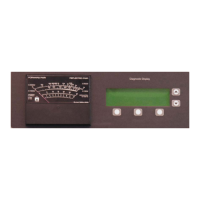
The FORWARD/REFLECTED POWER meter
has two scales. The upper scale is in-circuit when
the FORWARD/REFLECTED POWER switch is set to
FORWARD
.
The lower scale is in-circuit when the
FORWARD/REFLECTED POWER switch is set to
REFLECTED.
NOTE
The FORWARD/REFLECTED POWER meter has
square law scales. Resulting non-linearity makes it
difficult to read less than 400 watts on the upper
scale and 100 watts on the lower scale.
REMOTE OPERATION
4.9
Power adjustment and the transmitter's
on/off status can be controlled remotely. When the
control/monitor panel's CONTROL - REMOTE switch
is pressed, these functions are controlled from a
remote location. When the CONTROL - LOCAL
switch is pressed, the remote controls have no
influence. The remote alarm/status monitoring is
independent of and is not affected by the local/
remote selection.


 To Next Page