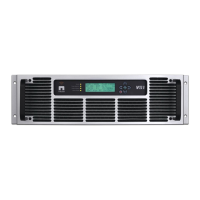
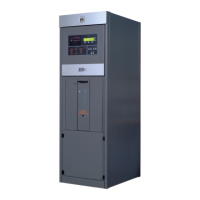
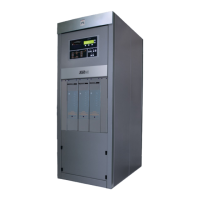
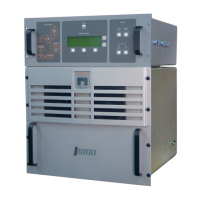
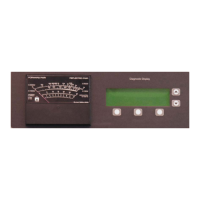
10 000 WATT FM BROADCAST TRANSMITTER
FM10
Page 4-1
01 October 2002
WARNING
SECTION 4
COMMISSIONING/OPERATION INSTRUCTIONS
GENERAL
4.1
The following instructions are primarily
intended for persons involved in the commissioning,
operating or maintenance of the equipment.
CONTROLS AND INDICATORS
4.2
It is highly recommended that the operator
be familiar with the transmitter controls and
indicators described in
section 3
before proceeding
with the transmitter commissioning.
EMERGENCY SHUTDOWN PROCEDURE
4.3
There are no special precautions to be
taken if an emergency shutdown is required, but the
type of shutdown will be dictated by the reason for
the shutdown. There are two types of shutdown, the
first turns off the RF output by turning off the RF
power amplifier module power supplies and the IPA
power supply. The second turns off the RF output
and disables all of the internal power supplies by
disconnecting the ac power source.
4.3.1 TURN-OFF OF RF OUTPUT: When the
cause of the emergency shutdown is external to the
transmitter or is in the RF output portion of the
transmitter, the following will turn off the RF power
module power supplies, IPA power supply and power
amplifier stages:
The following will not remove the ac power source
voltage from the main power transformer or inhibit
the output of the 24 VDC and 15 VDC power
supplies. If the reason for an emergency shutdown
requires all voltages to be turned off, proceed
directly to paragraph 4.3.2.
- If in remote control, select RF OFF at the
remote control site.
- If the front of the transmitter is accessible,
press and release the control/monitor panel's RF
OFF switch (local or remote control).
- Open any external interlock switch.
4.3.2 COMPLETE SHUTDOWN: When the
cause of the emergency shutdown dictates the need
for a complete shutdown of the transmitter, open
(turn off) the circuit breaker panel's MAIN POWER
circuit breaker or switch off the AC power source at
the service entrance.
PRE-STARTUP CHECKS
4.4
Prior to applying input power to the
transmitter, observe the following:
(a) Verify all assemblies/modules are installed and
mating connectors are fully engaged.
(b) Verify the external input/output wiring is
connected as detailed in paragraph 2.2.4.
(c) Visually inspect the internal wiring for defects
such as; damaged insulation, broken wires, and
wrong and/or loose connections.
(d) Verify all panels/covers are installed and their
attaching hardware is firmly tightened.
(e) Verify transmitter's RF output is terminated
into a 50 ohm load - an antenna that is
interfaced by an appropriate matching system
for normal operation, or a 50 ohm resistive
dummy load that is rated for at least 15000
watts for adjustment and testing procedures.
(f) Verify appropriate primary winding taps of the
power transformer have been selected to match
the voltage of the AC power source (refer to
paragraph 2.3.1).
(g) Verify the power source has a minimum rating
of 23kVA.
(h) Verify the program audio inputs have been
connected to the exciter audio inputs.


 To Next Page