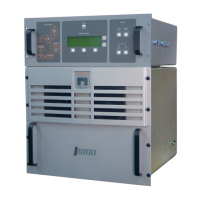
10 000 WATT FM BROADCAST TRANSMITTER
FM10
Page 4-4
01 October 2002
WARNING
(h) Using IPA input power probe's output cable
(W40), connect the exciter's RF output to the
IPA module's RF input connector (A17J5).
NOTE
Do not turn on the exciter until specifically
requested in the following procedures.
4.10.3 PRELIMINARY SETTINGS: Verify the
transmitter is ready to turn on as follows:
(a) Verify pre-commissioning requirements of
paragraph 2.2 and 2.3 have been completed.
(b) Set the circuit breaker panel's MAIN POWER
circuit breaker to OFF.
(c) Set IPA VOLTS potentiometer A14R116 fully
counter clockwise (minimum of twenty-four
turns), noting it is located on control/monitor
PWB A14. Refer to figure MD-2 as an aid in
locating this adjustment.
(d) Terminate the transmitter's RF output into a
precision 50-ohm dummy load, rated at a
minimum of 15 000 watts. If a dummy load is
not available, the system antenna may be used
as the load.
If a jumper is placed between the interlock inputs
(TB1-11 and TB1-12) on control/monitor PWB
A14, safety features provided by the external
interlocks will be disabled. It is recommended that
a fail-safe method of alerting personnel to this fact
be implemented. Voltages that are dangerous to
life will be present on RF output stages and the
antenna system if the transmitter is turned on.
(e) Close all external interlocks or temporarily
connect a jumper wire between TB1-11 and
TB1-12 of the control/monitor PWB.
(f) Obtain the
Proof of Performance Test
results
and the completed copy of table 5-6
Factory
Determined Measurements for Critical
Parameters
that were taped to the front of the
transmitter during packing for shipment. It is
recommended they be inserted into section 5 of
this manual along with the blank table 5-6 that
is provided. The blank table 5-6 is provided for
future transmitter testing/verification.
NOTE
The data in table 5-6 was compiled at the factory
with the transmitter terminated in a precision 50-
ohm dummy load. Measurements made on site into
a dummy load or the station antenna may not yield
the same readings. Slight variances are acceptable.
The data is provided as a routine maintenance and
trouble shooting aid.
4.10.4 INITIAL TURN-ON: Turn on the
transmitter and observe its alarm and status
indications as follows:
(a) Verify the requirements of paragraph 4.10.3
have been completed and are being met.
(b) Switch on AC power at the service entrance.
(c) Set all of the circuit breaker panel's POWER
SUPPLY CONTROL (PWR MDL A
thru F and
IPA) circuit breakers to their ON positions.
(d) Set the circuit breaker panel's MAIN POWER
circuit breaker to its ON position.
(e) The circuit breaker panel's AC ON lamp shall
turn on.
(f) Reset any inadvertent alarm indications (press/
release the control/monitor panel's ALARM
RESET switch). All alarm indications, except
the power supply control panel's FAN FAIL
alarm lamp, shall turn off. The FAN FAIL
alarm lamp shall be on.
(g) Pre-set the output voltage of all PA switching
power supplies to their minimum level
(simultaneously press/release the control/
monitor panel's TRANSMITTER OUTPUT
POWER - RAISE and LOWER switches).
4.10.4.1 Low Voltage DC Power Supplies: Check
the +24, +15, -15, +5 and B+ Volts power supplies
as follows:
(a) Set the DC SUPPLY VOLTAGE switch to +24V.
(b) The DC SUPPLY VOLTAGE meter's indication
should be a nominal 24 volts DC.
(c) Set the DC SUPPLY VOLTAGE switch to +15V.


 To Next Page