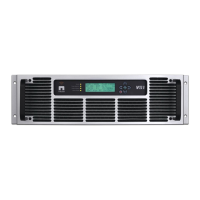
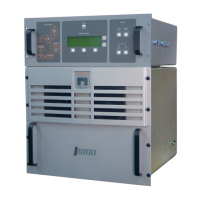
10 000 WATT FM BROADCAST TRANSMITTER
FM10
Page 5-4
01 October 2002
Table 5-2 Fuse Versus Power Amplifier FET
FUSE POWER FET
MODULE
A6A2F1 A (A18) Q1/Q2
A6A2F2 A (A18) Q3/Q4
A6A2F3 A (A18) Q5/Q6
A7A2F1 B (A19) Q1/Q2
A7A2F2 B (A19) Q3/Q4
A7A2F3 B (A19) Q5/Q6
A8A2F1 C (A20) Q1/Q2
A8A2F2 C (A20) Q3/Q4
A8A2F3 C (A20) Q5/Q6
A9A2F1 D (A21) Q1/Q2
A9A2F2 D (A21) Q3/Q4
A9A2F3 D (A21) Q5/Q6
A10A2F1 E (A22) Q1/Q2
A10A2F2 E (A22) Q3/Q4
A10A2F3 E (A22) Q5/Q6
A11A2F1 F (A23) Q1/Q2
A11A2F2 F (A23) Q3/Q4
A11A2F3 F (A23) Q5/Q6
RF POWER AMPLIFIER MODULE/IPA
MODULE FAULT ISOLATION
5.6
Determine if an RF power amplifier module
or IPA module is defective and then determine which
power amplifier(s) caused an alarm condition to be
generated, as follows:
NOTE
A defective RF power amplifier module can be
removed for repair, without turning off the
transmitter as described in paragraph 5.7. The
transmitter can be operated at a reduced output
power level (up to 7000 watts) with a module
removed. A defective IPA module, which will inhibit
the transmitter's RF output, can be replaced by an
RF power amplifier module as described in
paragraph 5.8. If the RF output power level has
been reduced slightly, suspect a defective RF power
amplifier module. If the RF output power level is
0.0 watts, suspect either multiple defective RF power
modules or a defective IPA module. If the RF output
level is zero watts, additional alarm lamps will
normally indicate the nature of the failure.
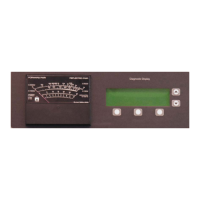
(a) Set the control/monitor panel's FORWARD/
REFLECTED POWER switch to
FORWARD
and
read the FORWARD/REFLECTED POWER meter
indication.
(b) If the meter reading in step (a) is the normal
operating level, the alarm is probably false.
Press/release the ALARM RESET switch.
(c) If the meter reading in step (a) is below the
normal operating level, it is probable that at
least one PA is not operating (failed).
(d) Verify all circuit breaker panel PWR MDL
circuit breakers are set to ON
and no power
supply control panel PA VDC PWR SPLY FAIL
lamps are on.
NOTE
MODULE RF DRIVE or MODULE TEMP lamps may be
on in conjunction with PA VDC PWR SPLY FAIL
lamps and will cause the associated PWR MDL
circuit breaker to trip off. Attempt to restore the RF
power module's RF output power by turning on the
PWR MDL circuit breaker and pressing the MODULE
RESET switch.
(e) If no other alarm lamps are on, identify a
defective RF power amplifier module by first
opening the control/monitor panel and the
access panel immediately below. Record the
RF power amplifier modules which have one or
more PA ALARM
lamps turned on.
(f) The status of the PA ALARM
lamps is controlled
by current detectors within the RF power
amplifier module which monitor the DC current
drawn by each PA. The associated PA ALARM
lamp will turn on if this current drops to near
zero due to:
- an interruption in DC voltage (PA volts) to a
particular PA (ie. fuse blown).
- a loss of RF drive power to a particular PA
possibly caused by an incorrectly set TUNE
switch or an open/short circuited drive cable.
- a failure of the associated PA's dual power
MOSFET possibly caused by a fault on the PA
input or output PWB, faults in the output cable
or overheating.
- a fault in the power module interface PWB's
PA current monitor circuitry.


 To Next Page