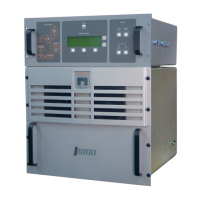
10 000 WATT FM BROADCAST TRANSMITTER
FM10
Page 5-5
01 October 2002
(g) If a pair of adjacent RF power module PA
ALARM
lamps is on (ie. Q1/Q2, Q3/Q4,
Q5/Q6), it is probable that a fuse has blown in
the associated switching power supply. Note
that power amplifier FETs in each RF power
module are fused in groups of two (i.e one fuse
for Q1 and Q2, one for Q3/Q4 and one for
Q5/Q6) at the output of the associated
switching power supply. Refer to table 5-2 to
determine the RF power module FET
associated with the switching power supply
fuse being measured.
NOTE
Failure of a power amplifier's power MOSFET will
rarely, if ever, cause the associated switching power
supply's fuse to blow. The device failure is
generally characterized by a short circuit from
drain to source which then opens very quickly -
faster than required for the fuse to act.
(h) Remove the protective cover from the
associated switching power supply and check
the fuses contained within.
(i) With a digital multimeter, measure the DC
voltage (nominally millivolts) across each of the
module's three fuses. If a digital multimeter
reading is:
- between 60 and 140 mVdc, the associated fuse
has not blown and DC current is consistent
with that drawn by two functional PA's. Refer
to para 5.6.1 for PA trouble shooting.
- approximately half of the nominal voltage
measured on the other two fuses, the associated
fuse has not blown and DC current is consistent
with that drawn when one of two PA's has
failed. Refer to para 5.6.1 for PA trouble
shooting.
- near zero millivolts, the associated fuse has not
blown and DC current is consistent with that
drawn when two PA's have failed. Refer to
para 5.6.1 for PA trouble shooting.
(j) Confirm that FET pair's associated fuse is
operational by measuring the voltage between
RF power module side of the fuse and ground.
The digital multimeter reading shall be the
nominal PA Volts supply level.
NOTE
If the voltage measured in step (j) is not the nominal
PA supply volts level, it is probable that the
associated fuse has blown. A blown fuse usually
indicates a short circuit was/is present between the
switching power supply output terminal and the
associated RF power module's PA output PWB.
(k) Set the associated PWR MDL circuit breaker to
OFF, wait until the B+ LED turns off and
remove the suspected blown fuse.
(l) Verify the resistance of the fuse is open circuit
and verify a short circuit does not exist between
the switching power supply's output terminal
and ground.
(m) If a short circuit does exist between the
switching power supply's output terminal and
ground, inspect wiring for broken insulation or
other obvious faults. If not, refer to paragraph
5.6.1 for PA trouble shooting.
5.6.1 POWER AMPLIFIER TROUBLE
SHOOTING: It has been determined (in paragraph
5.6) that the switching power supply, which provides
the PA voltage to the associated RF power module, is
functional. Examine other possible causes of the PA
ALARM lamp(s) as follows:
(a) If one or more PA ALARM
lamps are on and no
reduction in forward power has occurred, a
fault probably exists in the power module
interface PWB's PA failure detection circuitry.
NOTE
If it is necessary to check the power module
interface PWB's PA failure detection circuitry, refer
to the RF power module's service instruction manual
to isolate circuit defects.
(b) If a reduction in power has occurred, it is
probable that a PA has failed. Verify each
suspected PA's operational status by measuring
its RF output power as detailed in steps (c) thru
(g).
(c) Set the associated RF power module's PWR
MDL circuit breaker to OFF and wait until the
PA VDC lamp, on the rear of the RF power
module, has turned off.



 To Next Page