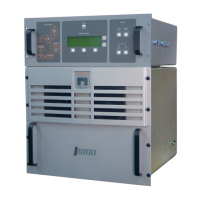
10 000 WATT FM BROADCAST TRANSMITTER
FM10
Page 5-11
01 October 2002
(c) Turn off RF power module selected as the
tuning PA volts source in step (e) of para
5.7.2.2, by setting its
PWR MDL
circuit breaker
to off.
(d) Mate P2 of the PA volts extender cable with J7
of the RF power module to be tuned.
(e) Ensure all output power amplifiers to be tuned
will not produce an excessive RF output by
setting their variable capacitor (C3) fully
clockwise.
(f) Connect the test setup's RF power meter to the
output connector (J1, J2, J3, J4, J5 or J6) for
the input/output power amplifier pair to be
tuned, as depicted in figure 5-1.
(g) On the RF power module interface PWB of the
RF module being tuned, set the TUNE/NORMAL
switch associated with the input/output power
amplifier pair to be tuned to TUNE.
NOTE
The remaining
TUNE/NORMAL
switches must be set
to
NORMAL
.
If more than one switch is set to
TUNE
,
it may result in destruction of MOSFETS in the
associated power amplifiers.
(h) Install or verify a 25W element is installed in
the test input power meter and it is set to
measure forward power.
(i) Turn on RF power module selected as tuning
PA volts source [turned off in step (c)] by
setting its PWR MDL circuit breaker to on.
(j) Measure the forward power level of the RF
drive being applied to the PA TUNE input of the
RF power module to be tuned, as indicated by
the input power meter. Measurement should be
between 7.0 and 12.0 watts depending on the
frequency of the power module being tuned.
Refer to table 5-4A for the correct power level
and adjust A14R116 IPA VOLTS until the
power stated in table 5-4A is achieved.
(k) Set the power meter's element to measure
reflected power and determine the reflected
power level of the RF drive, as indicated by the
input power meter. Measurement should be
less than 1.0 watt.
Table 5-4A PA Voltage Versus Frequency
CARRIER FREQUENCY PA PWR IN
87.5 - 89.9 7.0
90.0 - 92.9 8.0
93.0 - 95.9 8.5
96.0 - 98.9 9.5
99.0 - 89.9 10.5
102.0 104.9 11.0
105.5 107.9 12.0
(l) If reading in step (k) is more than 1.0W, adjust
C1 of the input power amplifier for the power
amplifier channel being tuned (see table 5-4)
for a null, which should be less than 1.0W.
(m) Replace the input power meter's 25W element
with a 1.0W element that has been set to
monitor reflected power.
(n) Adjust C1 of the input PA being tuned for a
null, which must be less than 0.01W.
NOTE
If a 0.01W null is not obtainable, the problem may
be the inductance of L1 on the input power amplifier
being tuned. If necessary, change the inductance of
L1 by changing the spacing between one or more of
its turns. It may be necessary to remove the metal
cover from the power amplifier to adjust L1. It must
be replaced to finalize tuning. Occasionally, at
high-end centre frequencies, fully squeezing L1 will
not provide sufficient inductance to properly tune
the PA input PWB. In this case, L1 may be replaced
by a slightly larger inductance coil (Nautel Part #
161-1019-05), located in the ancillary kit.
(o) When a null (less than 0.01W) has been
obtained, the input PA tuning is satisfactory.
(p) Adjust C3 of the output power amplifier for the
power amplifier channel being tuned (see table
5-4) for a 300W output to the dummy load, as
indicated by the output power meter's forward
power reading.
(q) Repeat steps (n) thru (p) until their
requirements are met without further
adjustment.
(r) Turn off RF power module being tuned, by
setting the PWR MDL circuit breaker of the RF
power module selected as the tuning PA volts
source to off.


 To Next Page