5-2
Okuma America Corporation
CONSTRCONSTR
CONSTRCONSTR
CONSTR
UCTIONUCTION
UCTIONUCTION
UCTION
Rev. 8-21-01
If the system is operated in an environment where the inductance is too high, the control will
generate an “excessive power source voltage fluctuation” alarm.
To verify the incoming power source is sufficient, divide the KVA rating of the machine by [the
square root of 3 (1.732) times the incoming voltage]. This will give you the amount of current
(amperage) needed to operate the machine.
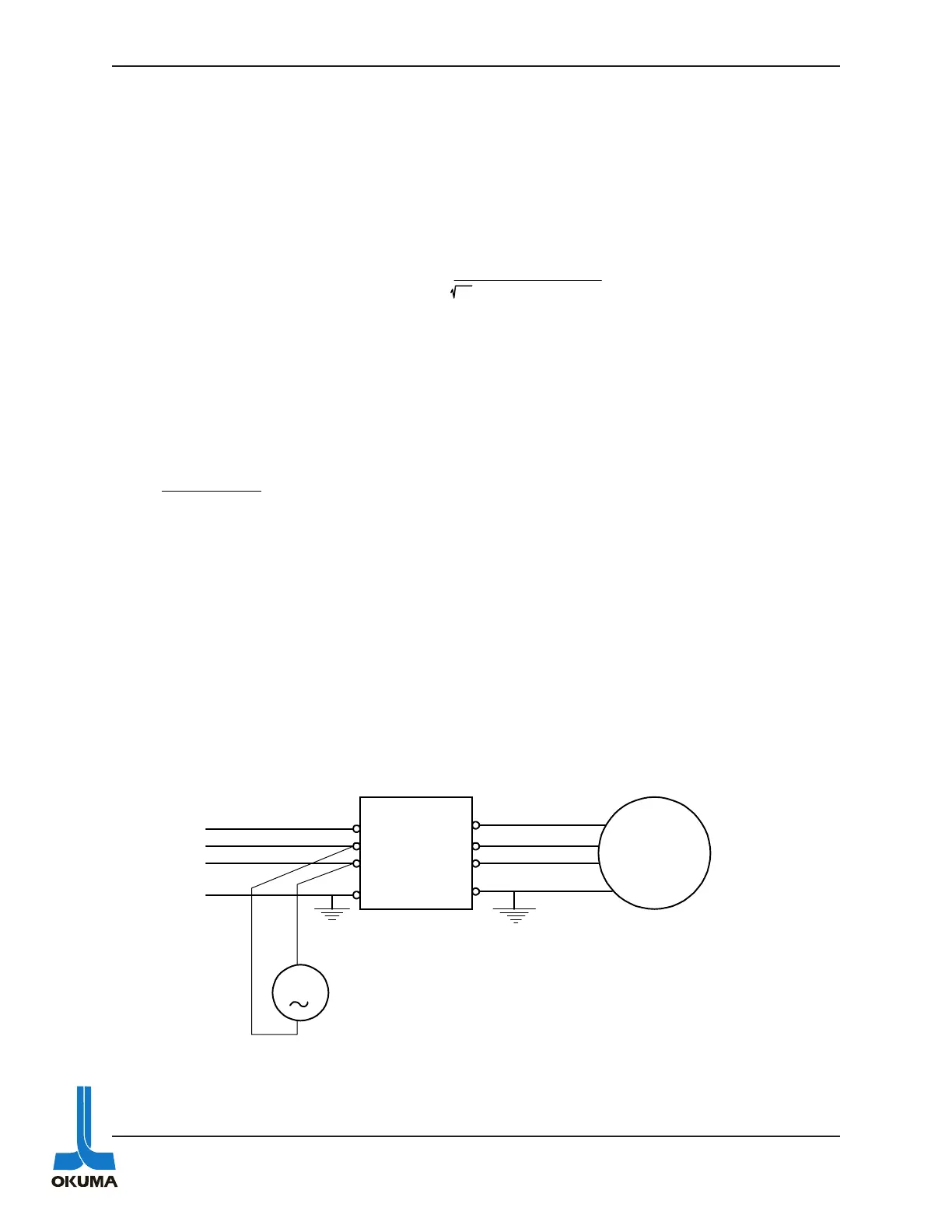
Another way to verify if the incoming power is sufficient is to check the impedance of the
incoming power. Impedance is the total opposition to the flow of current in an AC circuit. When
the spindle decelerates a load is put on the incoming power source and the voltage increases
slightly. This voltage variation has to be less then 6 %. To determine if the incoming power is
sufficient, do the following calculation:
In other words, (Vdec minus Vstop) divided by Vstop times 100% should be less than 6%.
Vstop is the voltage measured across the same to terminals of the spindle drive unit when it is at
a standstill. Vdec is the voltage measured across the same two terminals when the spindle starts
to decelerate.
When determining the Vdec the programmed spindle speed should be the maximum program-
mable spindle speed for the machine. The measuring device should be an analog volt meter or
an oscilloscope. Some of the latest DVMs are fast enough, i.e. Fluke 87.
KVA
I (amperage) =
X incoming voltage
3
Vdec - Vstop X100% = Vvar (Vvar should be less than 6% at 220V or 15% at 200V)
Vsto
AC
SPINDLE
MOTOR
V
SDU
R
T
S
E
U
V
W
E



 To Next Page