OMEM710 Hardware Manual 2v11
35
decrease the idle rpm, and when the idle is lower than target positive values are required to increase
the idle rpm. As the engine moves further away from the target speed, the numbers should increase.
Setting idle scatter control
Turn the scatter spark control off by setting Idle On Below RPM to 100rpm so that the engine
will not enter the idle condition.
With the engine warm set the natural idle (through adjusting air bleed screws or if necessary,
the throttle stop, remembering that if the throttle stop is moved, TPS min must be reset) to
approximately 150rpm higher than the target idle speed.
Turn the scatter spark idle control back on by resetting the Idle On Below RPM option to its
previous value.
Blip the throttle and the engine speed should return to the Idle FB Target RPM value.
As the engine is being given more air than is required to idle the engine when warm it retards the
ignition whilst in the idle condition to maintain the target engine speed. When the engine is cold it
requires more air to idle and so it benefits from the extra air, the ignition is advanced whilst in the
idle condition, and the engine has an improved cold idle speed.
Setting Hi Idle
With scatter spark control you simply set the Hi Idle options. As there is no idle motor to give the
engine extra air, the ECU will attempt to hold the Hi Idle speed, but will not be able to match it when
the engine is cold.
11.2 With air bypass idle motor
There are three types of air bypass motor; 2 wire spring return, 3 wire push/pull, and stepper motor.
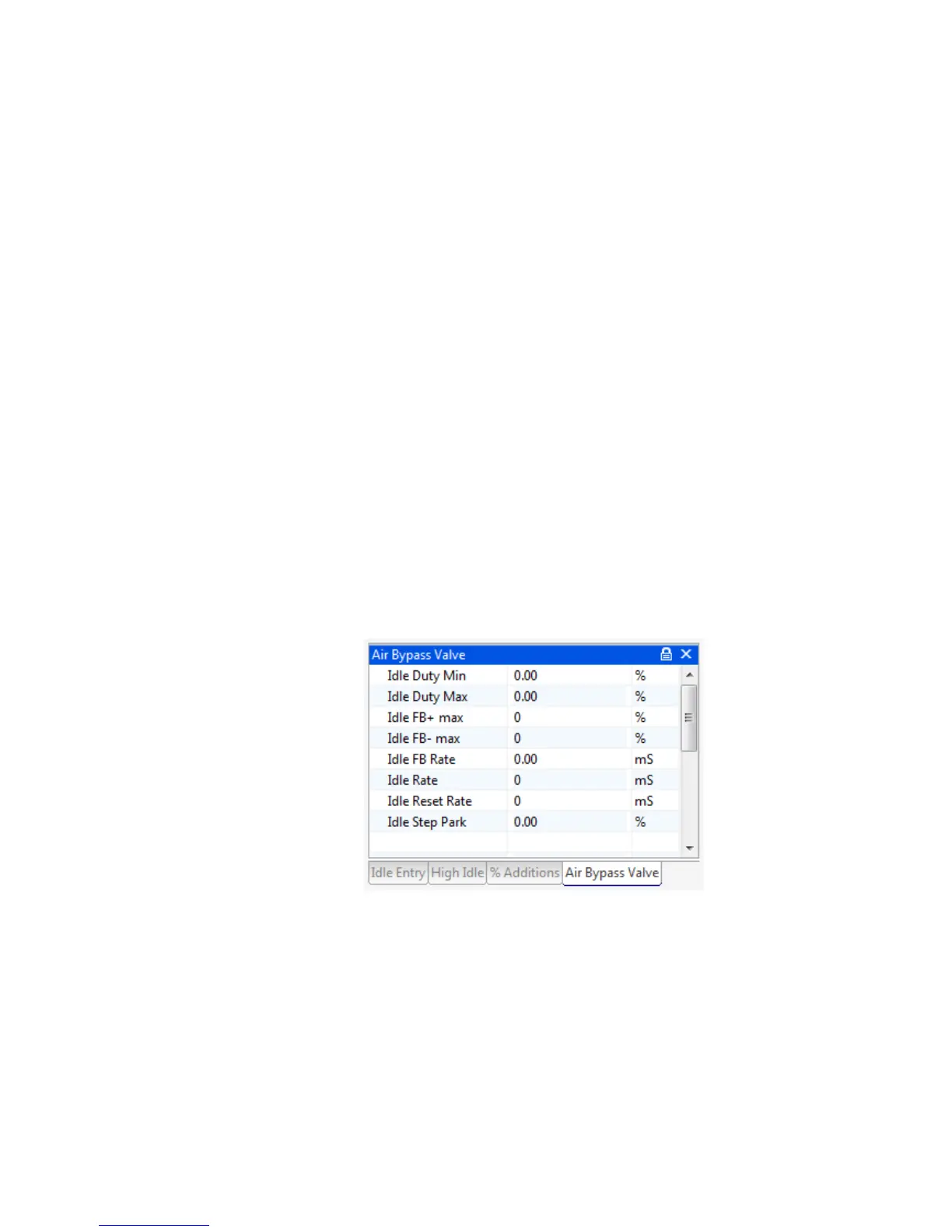
Idle Duty Max is the duty cycle above which the idle motor does not flow extra air.
Idle Duty Min is the duty cycle below which the idle motor does not flow any air.
The Idle Duty Coolant table gives the % opening of the idle motor required at each temperature to
achieve the base target idle.
The Idle Duty RPM table is a modifier based on engine speed for if the engine speed moves below
the target idle ie anti-stall. The target idle speed should have a modifier of 0. Engine speeds well
below target should have a large positive number to open the idle motor to stop the engine stalling.
The example below is typical for a 1000rpm idle.
The idle is then fine-tuned and maintained by the feedback loop. Idle FB- max and Idle FB+ max
are the feedback limits for the idle motor. The update rate of this feedback loop is set by Idle FB
Rate. This would typically be 40ms with a stepper motor or 200ms with a PWM device.


 To Next Page