Overview
1
11
Polyend Synth Manual
10
Polyend Synth Manual
Overview
1
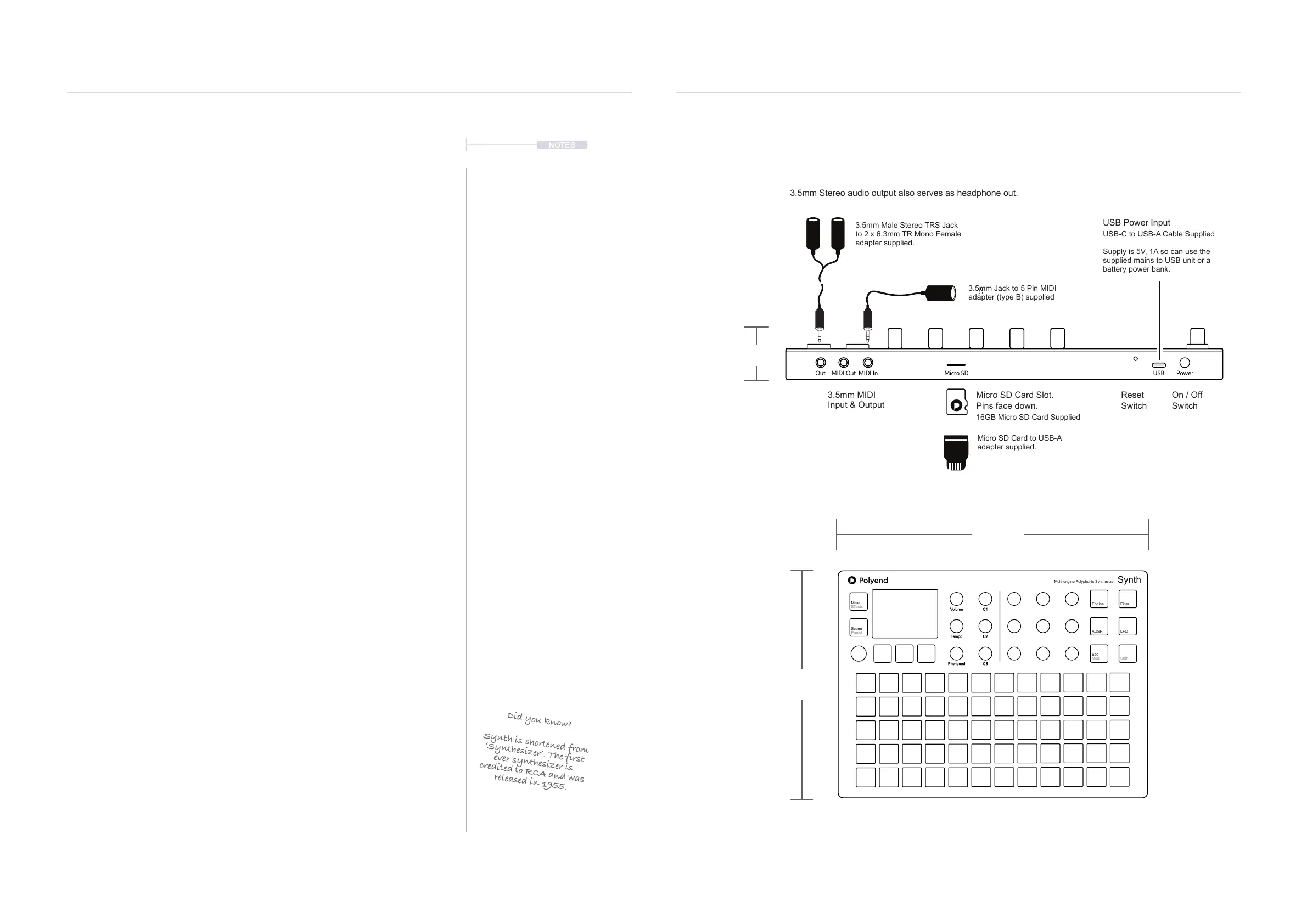
1.2 Hardware Overview
Your Notes Can be written here Here
NOTES
1.1 How to Use This Notebook
This book combines a formal reference alongside your own notes and
comments, collectively bringing together a comprehensive guide to Synth.
Sections are laid out to cover the full workow with walkthroughs, step by
step guides and tips. Some pages carry a wide margin and some are
intentionally blank enabling you to make your own notes.
Control conventions.
(Knob)
Rounded parentheses represent the touch capacitive knobs. Selected
functions can be controlled or changed depending on the context. The
knobs will be labelled by its primary or secondary function name. Also the
multi-function screen navigation knob is included, labelled as (Screen).
[Function]
Square parentheses contain functions that are selectable by a physically
dedicated button - either as a primary or secondary, shift accessible
function. Examples are [Engine] and [Scene].
[Function] + [Option]
Functions which require multiple button selections simultaneously are
shown with a + symbol between each required button. An example is the
[Shift] + [Effects] command. The secondary function label is named.
[Dynamic Screen Key]
The 3 dynamic screen buttons located underneath the display screen will
be identied using italic text. The actual function that each button serves
will change depending on the current context. The function it serves will be
labelled on the screen above each physical button on the device. These
also are used generically to select each one of the 3 synths.
[Pad]
Each of the 5x12 pad buttons will be simply represented by [Pad]. These
functions will depend on the mode and function selected within Synth.
‘Text’
Any screen menu options and text is indicated with quote marks.
Did you know?
Synth is shortened from
‘Synthesizer’. The rst
ever synthesizer is
credited to RCA and was
released in 1955.
Out MIDI Out MIDI In Micro SD
USB Power
On / Off
Switch
Reset
Switch
USB Power Input
USB-C to USB-A Cable Supplied
3.5mm Stereo audio output also serves as headphone out.
3.5mm MIDI
Input & Output
Micro SD Card Slot.
Pins face down.
16GB Micro SD Card Supplied
3.5mm Male Stereo TRS Jack
to 2 x 6.3mm TR Mono Female
adapter supplied.
Micro SD Card to USB-A
adapter supplied.
Supply is 5V, 1A so can use the
supplied mains to USB unit or a
battery power bank.
3.5mm Jack to 5 Pin MIDI
adapter (type B) supplied
282 mm
207 mm
35 mm
Mixer
Effects
Engine Filter
Scene
Preset
ADSR LFO
Seq
Mod
Shift
Volume
Tempo
Pitchbend
C1
C2
C3
Multi-engine Polyphonic Synthesizer
Synth


 To Next Page