SERVICE PROGRAM MODE 1 March, 2000
4-30
24: 2-125 (Drum Idling)
This mode has two options: “Fast” and “Slow”. Fast is the default setting and is
used with the new 16-kgf printing pressure setting. (See Pearl RTB No. 3 for more
details about the new printing pressure setting.)
Fast mode skips the 30-rpm drum rotation speed at the beginning of printing.
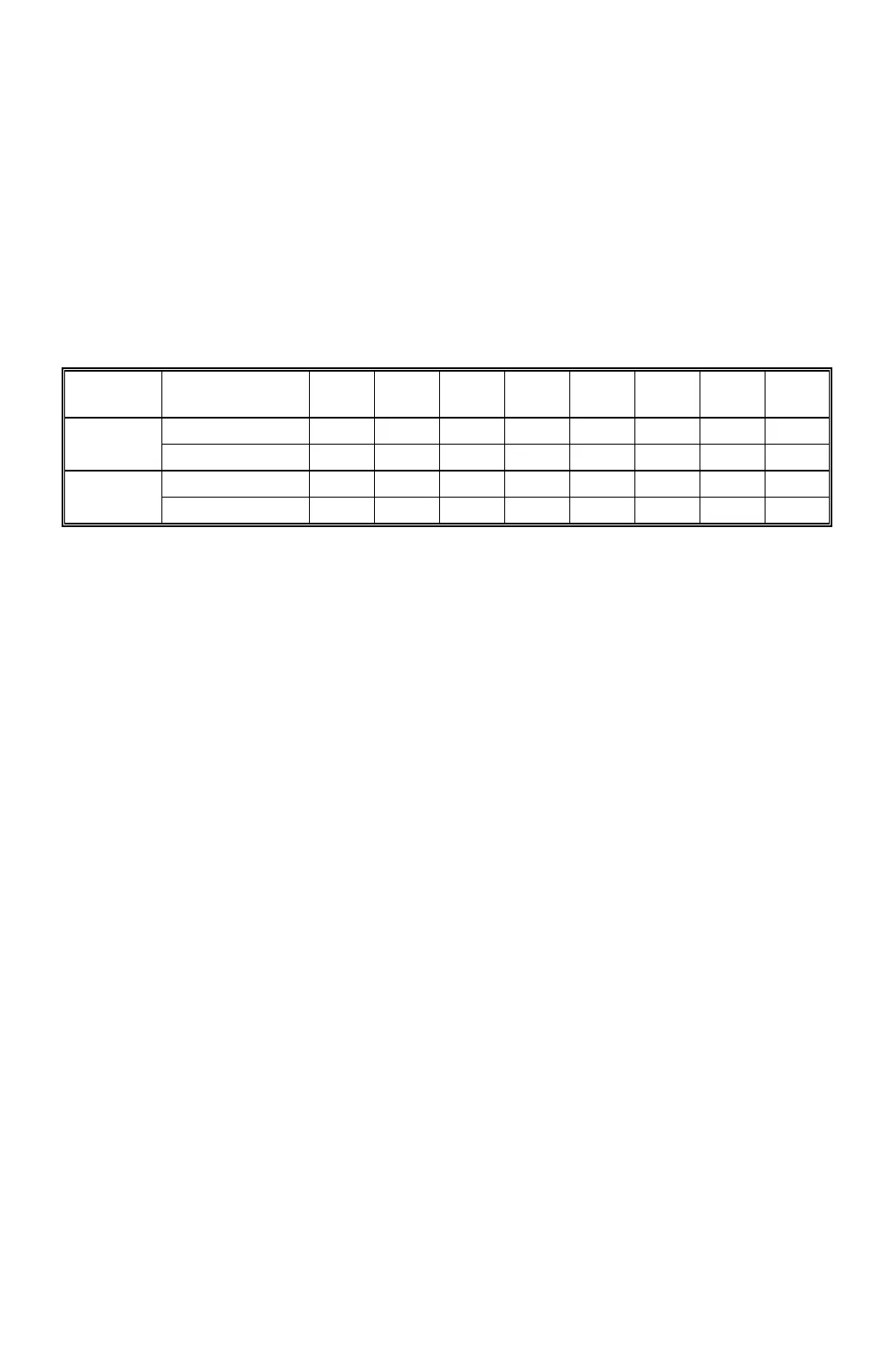
Consequently, the drum rotation speed increases as shown in the table below.
Slow mode does not skip the 30-rpm drum rotation speed. Note that there are two
cases depending on the temperature inside of the drum, detected by the
thermistor. With the ‘Slow’ setting, paper wrapping jams become more likely unless
the printing pressure is reduced to 14 kgf.
SP2-125
Setting
Drum
Temperature
Trial
Print
1st
Print
2nd
Print
3rd
Print
4th
Print
5th
Print
6th
Print
7th
Print
Below 15 °C
16 16
30
60 75 90 105 120
Slow
15 °C or above
16
30
60 75 90 105 120 120
Below 15 °C
16 16 60 75 90 105 120 120
Fast
15 °C or above
16 60 75 90 105 120 120 120
* These figures apply to the highest printing speed (120-rpm).
25: 2-150 (Auto Image Rotation)
If enabled, this feature rotates the scanned image if the original and printing paper
are of the same size but different orientations.
0: Disabled, 1: Enabled
Default: Enabled
26: 2-210 (Ink Near-end Detection)
This SP mode enables and disables the display for ink and master roll near-end
detection.
The machine determines how much of the master roll is remaining by subtracting
the length of each master that is made.
In addition, it determines how much ink is left by counting the number of ink pump
strokes that have been made.
The default is 0 (disabled). In this condition, the master and ink consumption is still
monitored, but if a near-end condition occurs, it will not be displayed.
If this SP mode is changed to 1 (enabled), near-end will be displayed, but only for a
few seconds when the machine has just been switched on.
27: 2-250 (Separation lines for Combine Original mode)
This can only be used with Memory Combine mode, using the optional memory
board.
This determines the type of separation line printed on copies between the images
of the different originals.
0: None (default), 1: Solid, 2: Broken line type A, 3: Broken line type B, 4: Crop
marks



 To Next Page