Need help?
Do you have a question about the Rion VA-11 and is the answer not in the manual?
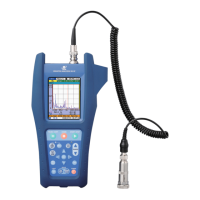
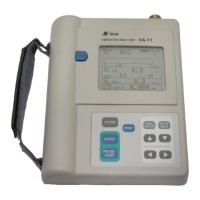
Describes controls and display elements on the front of the unit.
Instructions on how to use the provided strap for carrying the unit.
Details ports and switches located on the side of the VA-11.
Explains connectors and controls on the top surface of the unit.
Identifies the battery compartment location and its contents.
Instructions on inserting batteries and connecting AC adapter for power.
Guide on how to attach the accelerometer to the main unit.
Information on using external trigger signals for measurement control.
Details on connecting external devices like printers and computers via RS-232C.
Procedure for configuring the internal calendar and clock settings.
Guidance on utilizing the shoulder belt for convenient carrying.
Overview of information categories shown on the unit's display screen.
Details and examples of various measurement display modes (Vibration meter, Spectrum, Time waveform).
Explanation of the MAIN MENU and its sub-menus for parameter configuration.
How to adjust measurement parameters directly from the measurement screen.
Configuration options for external signals or input levels to trigger measurements.
Setting the trigger level and slope for waveform-based triggering.
Understanding how to capture data before or after a trigger event.
Explanation of when measurement processing begins and what parameters affect it.
Principles of averaging and peak hold processing methods.
Details on instantaneous value and exponential averaging techniques.
How FFT processing time is affected by zoom settings.
Information on the unit's internal memory for storing results.
Explanation of manual and transient data storing methods.
Step-by-step guide for using the unit as a vibration meter.
Instructions for operating the VA-11 as a spectrum analyzer.
How to view the top ten data levels from the spectrum graph.
Explanation of how to display and interpret time waveform data.
How to use the cursor to analyze data on spectrum and waveform displays.
Steps to enter the mode for viewing stored measurement data.
How to navigate through stored data by changing the memory address.
How to recall and view transiently stored waveform and spectrum data.
Ability to re-analyze previously stored time waveform data.
How to recall and view manually stored measurement data.
Visual examples of how frequency zoom affects display.
Visual examples of how Y-axis zoom affects display.
Instructions for correctly inserting a compact flash card into the unit.
Process of saving internal memory data to a compact flash card.
How to view the list of files and their dates on the flash card.
How to write data directly to the card during measurement.
How to delete data in block units from the flash card via the unit.
Procedure for formatting a compact flash card for use with the unit.
Lists default settings for core configuration menus.
Lists default settings for additional configuration menus.
Covers input channels, connectors, measurement quantities, units, ranges, and frequency.
Specifications for pre-stage and acceleration envelope filters.
Technical specs for Vibration Meter and Analyzer modes.
Details on RS-232-C interface, printer output, and external trigger.
Requirements for temperature, humidity, and power supply.
Physical dimensions and weight of the vibration analyzer unit.
Lists of supplied and optional accessories for the VA-11.
 General
| Frequency Range | 20 Hz to 8 kHz |
|---|---|
| Microphone | 1/2 inch electret condenser microphone |
| Measurement Range (Sound) | 30 dB to 130 dB |
| Time Weighting | Fast, Slow |
| Interface | USB |
| Measurement Functions | Sound Level |
| Weighting | A, C |
| Display | LCD |
| Data Logging | Yes |
| Standards | IEC 61672-1 |
| Type | Sound Level Meter |
| Output | USB |

 To Next Page