Model Railway Control Unit
WWW.Z21.EU
42
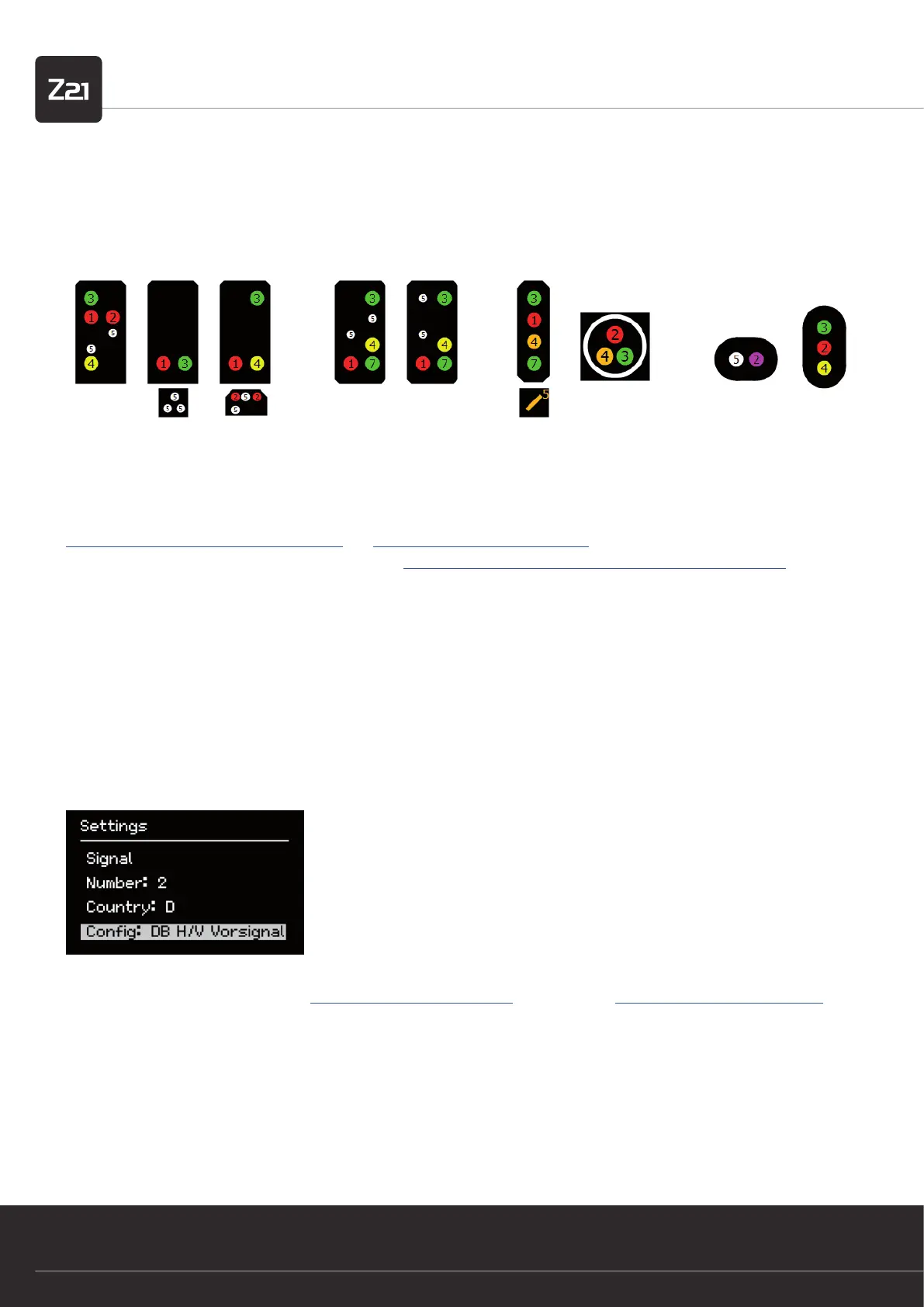
In delivery condition, the standard signal conguration “Universal” with the Signal-ID=71 is preset for all signals. This is a highly
exible conguration, using which different light signal types of simpler construction from different countries can be operated. In the
diagram, there is a small number on each lamp which describes on which terminal each lamp should be connected.
In addition to this all-purpose standard signal conguration, numerous other predened signal congurations from different countries
are available in the Z21 signal DECODER. You can select these signal congurations via CV #41 to #44. You can nd an overview
of the predened signal congurations, the respective assignments on the connection terminals and the respective signal aspects in
Appendix A – Signal conguration “Universal” and Appendix B – Signal congurations. There you can also nd the unique Signal-ID
for each signal conguration. You can nd all details on: https://www.z21.eu/en/products/z21-signal-decoder/signaltypen.
Should you require a different signal conguration for your signal, then proceed as follows:
1. Write down the required Signal-ID
2. Write this Signal-ID for the rst signal in CV #41 or for the second signal in CV#42, and if applicable for the third signal in
CV #43 or for the fourth signal in CV #44.
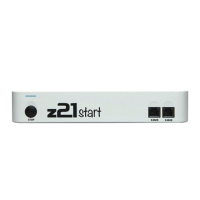
This is even easier with the Z21 per LINK: simply rst select in the “Settings” menu the rst, second and if applicable the third or fourth
signal (“Number”), then select the required country (“Country”), and nally the required signal conguration (“Cong”) – everything
is menu-driven and shown in plain text. No CV has to be programmed.
Please observe that the images shown in Appendix A – Signal conguration “Universal” and Appendix B – Signal congurations often
only show examples of a few signal screens. It is not usually possible to depict the drawings for all feasible conguration possibilities
for reasons of space. However, the logic is always the same within a signal conguration, and of course signal screens can also be
connected and operated with a reduced number of lamps. The same applies as for the prototype: do not switch a signal aspect if this
is in principle available in the selected signal type, but cannot be correctly displayed by the signal actually connected because the lamp
is not equipped! The SignalDecoder cannot automatically detect missing lamps, but rather must always assume that the signal type
variant is fully-equipped. Therefore, the user is responsible for only using expedient signal aspects which can actually be presented.


 To Next Page