EB 6493 EN 3-1
Design and principle of operation
3 Design and principle of oper-
ation
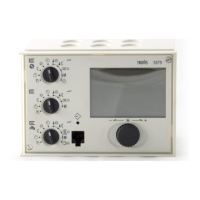
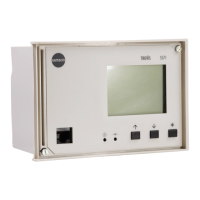
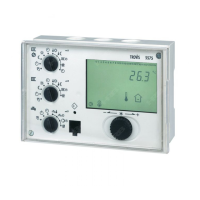
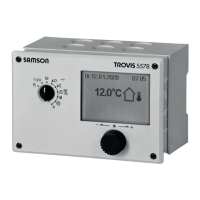
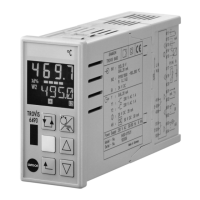
The TROVIS6493 Compact Controller is a
panel-mounted digital controller to automate
the industrial and process plants. It is suit-
able for control of continuous, on/off or
pulsing nal control elements (e.g. electro-
pneumatic positioners, electric actuators,
heating systems, refrigerating machines etc.)
The controller is congured to adapt it to
control tasks. The controller settings are
saved in a non-volatile memory, even when
the power supply fails. It can be protected by
a key number.
Control modes
The compact controller is designed for xed
set point and follow-up control. Two internal
set points and one input for the external set
point are available.
Default settings
The default compact controller is a tempera-
ture controller for xed set point control with
the internal set point W that operates as a PI
controller.
The controlled variable is measured at the
analog input IN2 (Pt100 resistance ther-
mometer).
The 4 to 20mA control signal is issued at the
analog output Y.
Analog inputs
The analog inputs IN1 and IN2 can be ad-
justed to the following ranges:
− 0 to 20mA, 4 to 20mA, 0 to 10V, 2 to
10V
− Pt100, Pt1000, Ni100, Ni1000 resis-
tance thermometers in three-wire circuits:
The resistance of each connection lead
must be the same and not exceed 15Ω.
Resistance thermometers can also be
connected in two-wire circuits.
In two-wire circuits, take into account that the
lead resistance may reach several ohms over
long distances, causing the measured value
to be considerably distorted. This measured
value can be compensated for by a correc-
tion value (see '-CO- F.FOR Feedforward
control' in the Conguration Manual
uKH6493).
− Potentiometer 1kΩ (resistance transmit-
ter) in three-wire circuit:
A potentiometer is used, for example for
position feedback of an electrical actua-
tor or for input of an external set point.
The controller is congured to assign an in-
put to the controlled variable X and the other
input to the input variable WE. The input
variable WE can be used as an external set
point, feedforward control input value (auxil-
iary controlled variable) or external position
feedback. The '-CO-F.FOR Feedforward
control' function allows two input variables
to be added or subtracted. For example, a
Note


 To Next Page