Multi-Port Optical Power Meter MPM-210
5-21
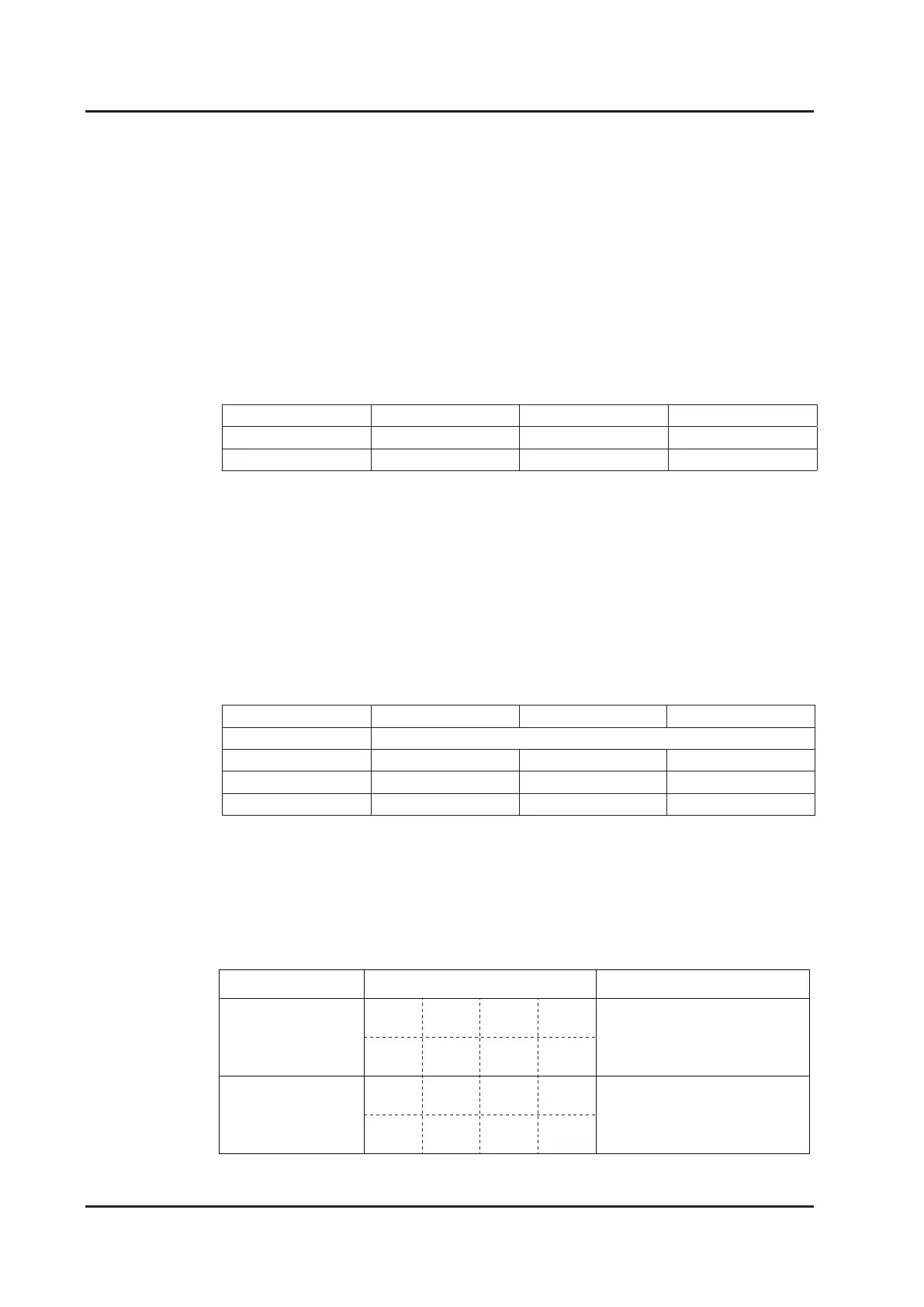
Name Sign bit Exponent bit Fraction bit
Symbol S E F
Bit 31(MSB) 30 ~ 23 22 ~ 0(LSB)
Binary data format used in MPM-210 is IEEE Standard Floating Point Format as in
Table 5.6.2. (Note: Binary data is sent every 8 bit from least signicant byte to most
signicant byte.)
Table 5-6-2
Floating Point Data Structure
Sign bit is the 31st bit. ‘0’ means a positive number and ‘1’ means negative number.
Exponent is composed of 8 bits from the 30th bit to the 23rd one, and it can express
a number between 0~255. The median of Exponents is 127. If Exponent is larger than
127 it is positive, and if it is smaller than 127 it is negative. That is, 127 means 20,
128 21 and 126 2-1. Fraction indicates a decimal below 1. The 22nd bit is the decimal
number of 1/2, the 21st bit the decimal number of 1/4, and the 20th bit the decimal
number of 1/8. Each of the lower bits expresses its corresponding number in the same
rule. Based on this structure, binary floating point data are converted into decimal
numbers as in Table 5.6.3.
Description Sign bit Exponent bit Fraction bit
Decimal Value (-1)
S
x 2
E-127
x (1 + F x 2
-23
)
NaN Don’t Care 255 ≠ 0
-Innite 1 255 0
+Innite 0 255 0
Table 5-6-3
How to convert binary oating point data into decimal numbers
Represents the transformation example 4 byte binary data as below.
Example)
Hexadecimal 4 Byte data
Data
Measurement data
4 Byte data Description
Converted data from
original data
Original 4 byte data is separated
every 8 bit. Each 8 bit rearranges
from the last 8 bit data to the first
8 bit data
IEEE Standard Floating Point
Format
C7 D7 9D BE
C7D79DBE
1
st
Byte 2
nd
Byte 3
rd
Byte 4
th
Byte
1
st
Byte2
nd
Byte3
rd
Byte4
th
Byte



 To Next Page