26 GSM-X SATEL
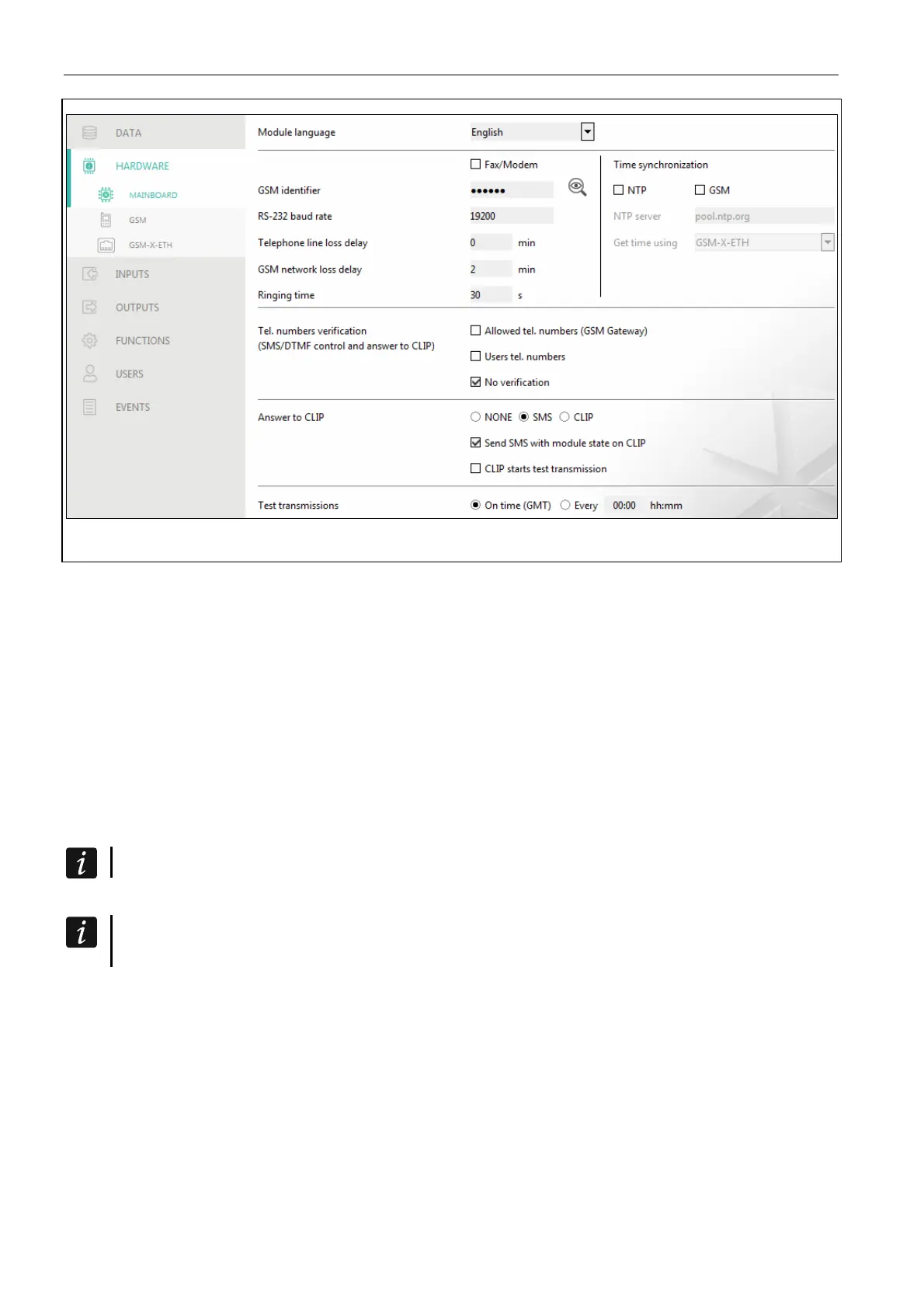
Fig. 25. “Mainboard” tab.
RS-232 baud rate – the rate of data transfer through the RS-232 port. The factory default
setting: 19200.
Telephone line loss delay – the time after which the module will signal the loss of analog
telephone line. Values from 0 to 99 minutes can be programmed. Programming the value
0 means that the module will not signal any trouble.
GSM network loss delay – the time after which the module will signal the GSM telephone
trouble. Values from 0 to 99 minutes can be programmed. Programming the value 0
means that the module will not signal any trouble.
Ringing time – the time during which the incoming GSM call can be answered by the device
connected to the telephone line output. After this time has elapsed, the control from the
telephone keypad (DTMF) will be available. Termination of the connection before this time
elapses is interpreted as CLIP. Values from 0 to 99 seconds can be programmed.
It is recommended that the voice mail be disabled.
Time synchronization
The module uses the Greenwich Mean Time (GMT), not the local time (the time zones
are not taken into account).
NTP – if this option is enabled, the module clock is synchronized with the time server.
GSM – if this option is enabled, the module clock is synchronized with the time of GSM
network operator.
NTP server – time server address. The field is available if the “NTP” option is enabled. You
can enter the IP address or domain name.
Get time using – you can select a channel for communication with the time server:
GPRS – GSM network.
GSM-X-ETH/GPRS – Ethernet network or GSM network. Ethernet has priority over GSM.
GSM network is used if there is no Ethernet communication.
GSM-X-ETH – Ethernet network.


 To Next Page