7 General Description of Functions
EN-US · 30.30.00.00424 · 07 · 10/23 29 / 86
7General Description of Functions
7.1Applying Suction to the Workpiece/Part (Vacuum Generation)
WARNING
The Compressed Air Supply of the Vacuum Generator Fails During Operation.
Danger of falling parts because the vacuum for the vacuum gripper collapses quickly.
4 Ensure that the compressed air supply does not fail during operation.
4 Carry out a risk assessment for each application.
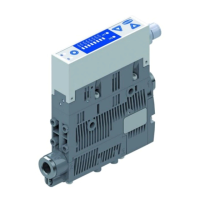
The ejector is designed for handling and holding workpieces by means of a vacuum in combination with
suction systems. The vacuum is generated in a nozzle according to the venturi principle, using suction
generated by the flow of accelerated compressed air. Compressed air is channeled into the ejector and
flows through the nozzle. A vacuum is generated immediately downstream of the motive nozzle; this
causes the air to be sucked through the vacuum connection. The air and compressed air that have been
removed by the suction exit together via the silencer.
The venturi nozzle on the ejector is activated and deactivated using the suction command:
• In the NO (normally open) version, vacuum generation is deactivated when
the suction signal is received.
(This means that if the power fails or if no control signal is present, vacuum
is constantly generated (continuous suction).)
• In the NC (normally closed) version, vacuum generation is activated when
the suction signal is received.
(This means that if the power fails or if no control signal is present, no vac-
uum is generated.)
• In the variant IMP, the venturi nozzle is actuated using the same principle as
the variant NC. This means that the ejector switches to “suction” mode
when a pulse is present.
In the ejector variant IMP, the ejector remains in “Suction” mode if the power supply fails during auto-
matic operation. This prevents objects that have been picked up from falling off the suction cup in the
event of a power supply failure. This also applies when the ejector is in “venturi nozzle inactive” status
with the air saving function activated. In this case, the ejector switches to “venturi nozzle active,” i.e., to
continuous suction. When the power supply returns, the ejector remains in automatic operation with the
air saving function activated. If the ejector is in “blow off” mode when the power supply fails, the blow
off is stopped and the ejector is set to “pneumatically OFF” status. This prevents unnecessary consumption
of compressed air, thus saving energy and additional costs. When the power supply returns, the ejector
remains in “pneumatically OFF” status.
An integrated sensor records the vacuum generated by the venturi nozzle. The exact vacuum value:
• is shown on the display
• is evaluated by an electronics system and serves as the basis for displaying
system statuses



 To Next Page