Date Code 20011026 Maintenance and Testing 7-7
SEL-321/321-1 Instruction Manual
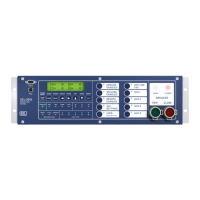
Target LED Explanation
The INST target illuminates when the relay trips for a protection element that has been asserted
for a time less than the relay ITTD setting.
The TIME target illuminates when the relay trips for a protection element that has been asserted
for a time greater than the relay ITTD setting.
The Zone targets indicate the zone of the element that caused the trip. The A, B, C, and G targets
indicate the phase involvement. The Q target indicates that a negative-sequence overcurrent
element was asserted at the time of trip.
The 50 and 51 targets indicate trips based upon overcurrent element operation. The 50 indicates
instantaneous and definite-time delayed overcurrent element operations. The 51 indicates time-
overcurrent element operations.
The COMM and SOTF targets indicate when the trip occurred as part of a Communications-
based operation or a Switch-Onto-Fault operation, respectively.
Section 2: Specifications includes detailed information regarding operation of the relay targets.
Front Panel LCD Explanation
The relay generates an event report for each fault. To see the summary event report for the last
fault, press the FAULT button on the relay front panel and use the Up, Down, Left, and Right
arrow buttons to review the information presented there.
If a new fault occurs while you are reviewing the fault data, press the EXIT button, then the
FAULT button to review the new data.
You may review the long form event report for each fault using a terminal connected to one of
the relay serial ports. Each event report is an eleven-cycle record of the currents, voltages, relay
element states, and logic input and contact output states. The relay saves the twelve newest
reports. See Section 3: Communications and Section 4: Event Reporting for further details on
the retrieval and analysis of event reports saved by this relay.
TESTING PHILOSOPHY
Protective relay testing may be divided into three categories: acceptance, commissioning, and
maintenance testing. The categories are differentiated by when they take place in the life cycle
of the relay, as well as in the test complexity.
The paragraphs below describe when each type of test is performed, the goals of testing at that
time, and the relay functions that you need to test at each point. While this information is
intended as a guideline for testing SEL relays, each utility must determine its own testing
practices.


 To Next Page