Date Code 20011026 Maintenance and Testing 7-29
SEL-321/321-1 Instruction Manual
When you apply the voltage signals shown above, V
2
is 180° out of phase from V
A
.
Take this into account, and calculate the angle of I
A
with respect to the angle of V
A
.
Equation 7.2 yields a positive result when I
A
leads V
A
by (180° - ∠Z1ANG°).
Equation 7.2 yields a negative result when I
A
lags V
A
by ∠Z1ANG°.
We are testing for positive values of Z2c, so I
A
should lead V
A
by (180° -
∠Z1ANG°). Assuming that V
A
= 49.0 ∠0° volts, the angle of I
A
for this test should
be 96°.
Calculate the magnitude of A-phase current where Z2c equals Z2RT or Z2FT using
Equation 7.7:
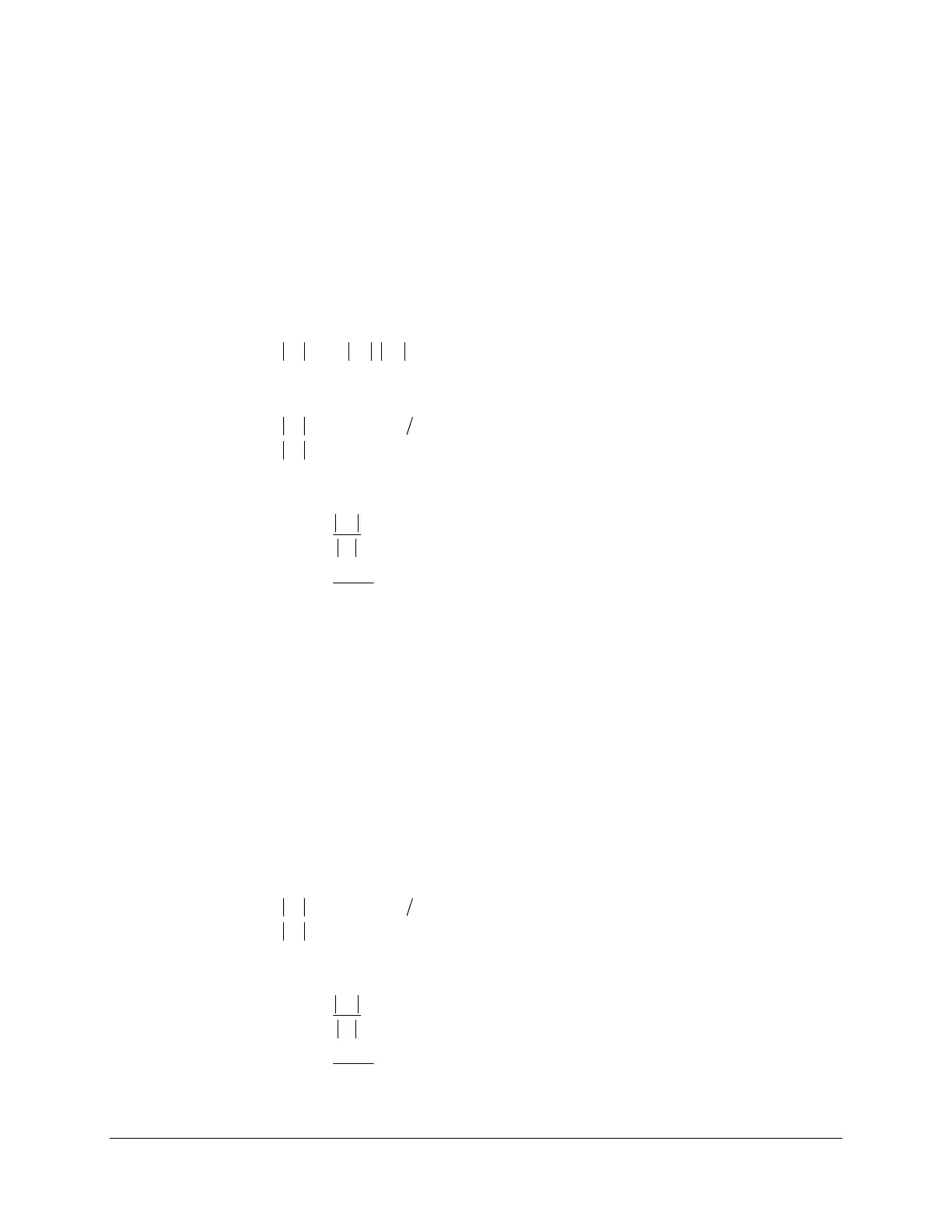
()
22A
Z/V•3I = Equation 7.7
For Z2R = 5.45 Ω:
()
amps3.3I
ohms45.5volts0.6•3I
A
A
=
=
Calculate Z2m:
ohms45.5m2Z
A1.1
V0.6
m2Z
I
V
m2Z
2
2
=
=
=
Because Z2R is positive, use Equation 7.5 to calculate Z2RT.
() ()
ohms45.5RT2Z
45.5•25.045.5•75.0RT2Z
m2Z•25.0R2Z•75.0RT2Z
=
+=
+=
The 32QR element asserts when Z2c applied is greater than Z2RT. As the
magnitude of I
A
is increased, the magnitudes of Z2c and Z2m decrease. For
magnitudes of I
A
less than 3.3 amps, 32QR asserts, given the other test quantities.
For I
A
magnitudes greater than 3.3 amps, Z2c is less than Z2RT, so 32QR deasserts.
For Z2F = 0.77 Ω:
()
amps4.23I
ohms77.0volts0.6•3I
A
A
=
=
Calculate Z2m:
ohms77.0m2Z
A8.7
V0.6
m2Z
I
V
m2Z
2
2
=
=
=


 To Next Page