H-2 MIRRORED BITS Communications Date Code 20011026
SEL-321/321-1 Instruction Manual
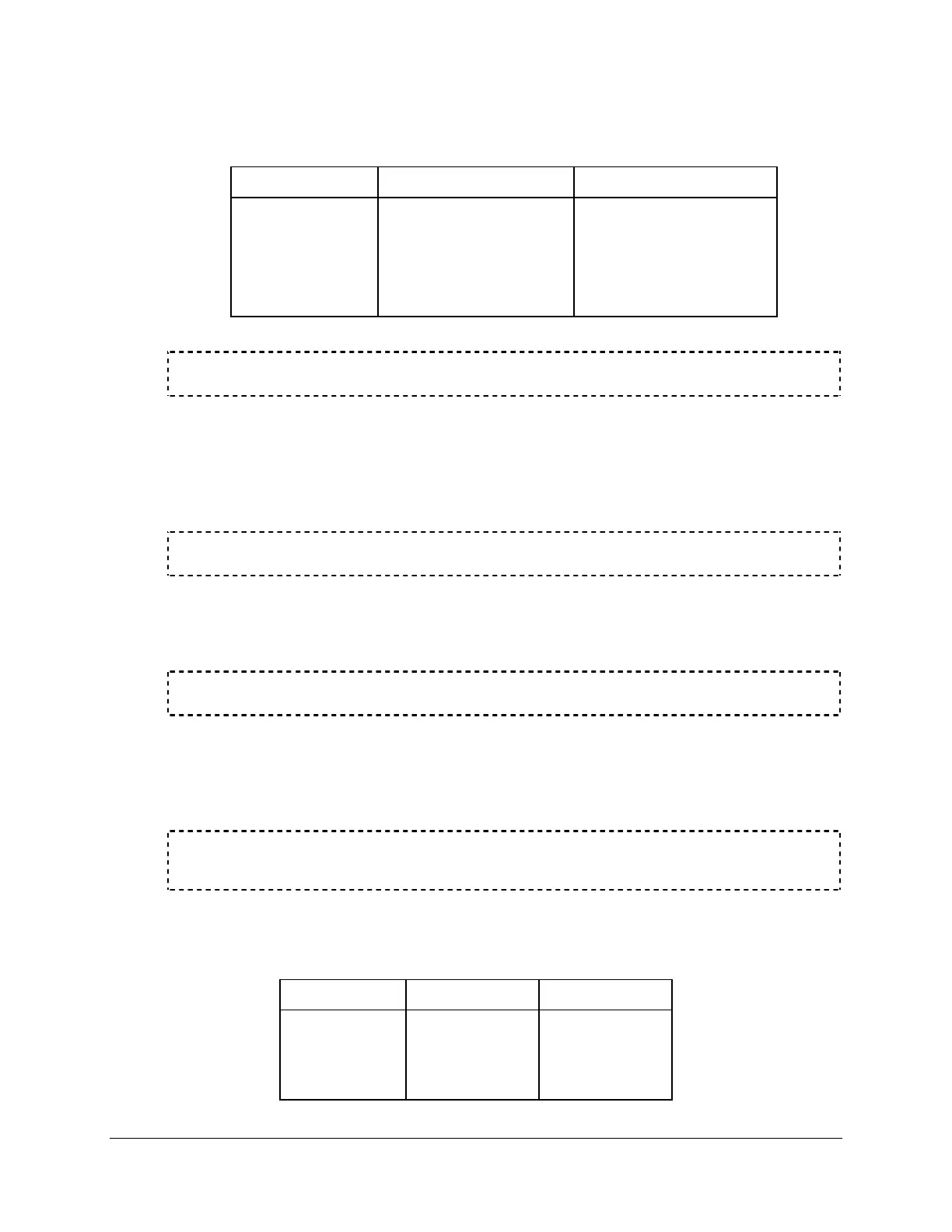
Use the SPEED setting to control the rate at which the MIRRORED BITS messages are transmitted,
in power system cycles. The following table indicates the worst-case message per cycle rate.
SPEED SEL-321 SEL-351
38400 1 message per 1/8 cycle 1 message per 1/4 cycle
19200 1 message per 1/4 cycle 1 message per 1/4 cycle
9600 1 message per 1/2 cycle 1 message per 1/2 cycle
4800 1 message per 1 cycle 1 message per 1 cycle
enable hardware handshaking (Y,N,MBT) RTS_CTS= N ?
Use the MBT option if you are using a Pulsar MBT 9600 baud modem. With this option set, the
relay will transmit a message every 3/8 power system cycle and the relay will deassert the RTS
signal on the EIA-232 connector. Also, the relay will monitor the CTS signal on the EIA-232
connector, which the modem will deassert if the channel has too many errors. The modem uses
the relay’s RTS signal to determine whether the new or old M
IRRORED BITS protocol is in use.
Mirrored Bits Receive bad pickup (1- 10000 sec) RBADPU= 60 ?
Use the RBADPU setting to determine how long a channel error must last before the relay
element RBAD is asserted. RBAD is instantaneously deasserted when the channel error is
corrected.
Mirrored Bits Channel bad pickup (1- 10000 10E-6) CBADPU= 1000 ?
Use the CBADPU setting to determine the ratio of channel down time to the total channel time
before the relay element CBAD is asserted. The time used in the calculation are those that are
available in the COMM records. See the COMM command in the SEL-321 or SEL-351 manuals
for a description of the COMM records.
Mirrored Bits transmit identifier(1 - 4) TX_ID = 1 ?
Mirrored Bits receive identifier(1 - 4) RX_ID = 2 ?
Set the RX_ID of the local relay to match the TX_ID of the remote relay. For example, in the
three-terminal case, where Relay A transmits to Relay B, Relay B transmits to Relay C, and
Relay C transmits to Relay A:
Relay TX_ID RX_ID
A 1 3
B 2 1
C 3 2


 To Next Page