DESCRIPTION
Introduction
The
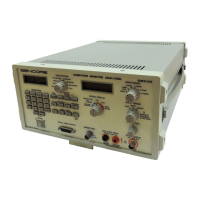
SC61
Waveform Analyzer
represents
the
Hl'St
improvement
in waveform measuring techniques since the
nrst
oscilloscope
was introduced
over 50 years ago. Before the 5C61, all oscillo-
scopes were stricti)' analog devices. Every measurement of
peak-to-peak amplitude. time,
or
frequency required matching
the
wa\'eform to
CRT
graticule markings, estimating parts
of
a
CRT
division or
part
of
a cycle of
the
wa\-efonn
and
multipl)ing
the size of
the
waveform times
the
setting of
the
horizontal
or
vertical s
....
itches. The measurements were not vel)' accurate
(I)'pical accuracy on an analog
SC()pe
is
±15l\) when interpreta·
tion
error
is
considered), were time consuming, and were
subject
10
many errors (such
as
forgetting to turn the vernier
10
the
calibrated
position).
The
SC61
combines the
w3\'eform
analyzing
capability
of a high
qualityoscilloscope
....
ilh
thespeed,
atturacy.
andfreedom from
eITOrs
of
a computer. The
SC:61
has a microcomputer that
monitors the
vertical and horizontal circuits
at
all times.
You
just push a button when you
.....
ant to measure all or
part
of
a
.....
aveform.
The
microcomputer
determines
the reading,
automatically
sets
the decimal, and produces a direct digital
readoutof thevalue.
Features
The
SC61
Waveform Analyzer
starts
""ith a high quality oscillo-
scope. The CRT display section
has
a band""idth of
60
MHz. and
is
useable to
100
MHz
to sho
.....
the needed detail when anal)Ling
digital signals. Speciall)' designed sync circuits (using differen-
tial amplifiers and emitter-eoupled logic stages) provide solid
triggering
'A'ith
the fewest trigger adjustments possible. The
input capabilities extend from 5 millivolts
per
di
...
ision all the
way to
200lI
volts DC
or
AC
peak-to-peak_
Special
video circuitssimplify analyzingcomposite \ideo wa\'e-
forms. Sync
separators
produce stable triggering on
these
complex signals. Additional stages eliminate the half-line shiH
on
interlaced signals, while others eliminate
ventcal
sync from
interfering
with digital readings of signals displa)'ed
at
the hori·
zontal sweep rate. Video preset buttons allo
.....
pushbutton selec-
tion
of
vertical
or
horizontal
scanning
frequencies.
There
are
two types
of
digital measurements made through the
same
probe
used
for the CRT display. The first
three
functions
for each channel
are
called the Auto-Tracking
TIo1
tests. Auto-
Tracking means the microcomputer automatically tracks the
CRT display
at
aU
times. The three Auto-Tracking functions
are
DC
volts. peak-to-peak \·olts. and frequency.
All
three functions
measure
the
entirewa\'eform_
The
second group of digital tests
are
the Delta tests which let
you
measure
part
of
a waveform. These tests measure the peak·
to-peak amplitude, time,
or
frequency of any
part
of
the wa\'e-
form shown on the CRT.
Both
types of digital tests
are
unaffected by the vertical
or
hori·
zontal verniers
or
position controls, allo
.....
ing
the
CRT display to
be an)' size you want without affecting the accuracy of the
digital readout.
All
tests
are
automatically ranged
or
directly
interfaced to the
input attenuators for d.ireet readings.
One
fmal test allows
the
frequency
of
the signal applied to
channel A to be compared to the frequency
of
the
signal applied
to
cl1annel
B.
The digital display shows the ratio of the two
frequencie-
to troubleshoot divider
or
multiplierstages.
4
SC6J
Specifications
Analoe
CRT
S<!ctlon
Vertical Amplifiers:
Frequency Response:
±3
dB,
DC to 60
MHz,
useable to
100
MHz.
AC
coupled:
±3
dB,
10
Hz to 60
MHz.
Risetime: 6 nanoseconds.
Deflection Facton.:
12
calibrated ranges in
1-2-5
sequence cali·
brated to read
d.ireet ",,;th supplied
39G183
lOX
probes. Con-
centric vernier continuously variable between ranges ""ith
detent for calibrated position.
sensitivity:
50
mV/di
....
to
2OOVldiv.
with supplied
lOX
probes.
5mVldiv. to
20V
ldiv. direct.
Calibration Accuracy: ±4% from
20-
to
30°C
(68-
to
Sti°F) for
channel A
and/or
B:
±10$
for
A+BorB-A
modes.
input
Impedance:
10
megohms shunted by
15
pF
....
ith
39G183
lOX
Iov.--capacity probes, 1megohm shuntedby
50
pF
d.ireet.
Maximum input Voltage:
3000
volts (DC +
Peak
ACj
through
39G183
probes.
500
...
olts (DC +
Peak
AC)
direct. Derated for
frequencies above
650
KHz.
Protected to
3000
volts
IDC
+
Peak).
Input
Coupling:
AC.
DC,
and Ground.
Timing:
iO
nS
delayline for both channels to show triggerpoint.
Invert:
A\'3.iIable on channel Ab)' pulling vertical position knob.
Display Modes: Channel
A,
il1\'erted channel A I-A), channel
B,
dual
trace
(A&B). algebraic sum
(A+B)
or
difference (B-:\),
and
\'ector IX·V).
Dual
Trace:
..
\utomatically switches bet
.....
een duaJ-alternate
and
dual·chopped
(approximately
500
KHz chopping
frequency) depending
on
s
.....
eep
rate
when ..
A&B"
button
pressed. Forced to dual-alternate for
aU
sweep
rates
if
aU
CRT display buttons
are
released
to
out position.
Vector: Channel A
is
Y axis, channel B
is
X axis. Bandwidth:
±3dB[rom
DC
to.;
MHz.
Phaseshift: ±3- from
10
Hz to';
MHz.
sensitivity: Same
as
vertical amplifiers.
Z-Axis Input:
BNC
input on
rear
panel.
DC
coupled:
..£.5
volts
blanks
trace. Frequency range: DC
tQ
5 :\IHz. Protection:
35
vailS
DC
+
Peak
AC.
Horizontal Sweep:
Timebase:
19
calibrated sweep
rates
in
1-2-5
sequence. Concen·
tric \'ernier continuously variable bet
.....
een steps ""ith detent
for calibrated position.
Sweep Rates: 100 milliseconds/division
tQ
.1
microsecond!
d.i\;sion.
Aceuracy:
±4C\
from
20°
to30-C (68-l086°Fl.
Video
Presets:
Activated in 20th switch position. Pushbutton
selection of 2 horizontal lines
or
2 vertical fields
of
standard
~"TSC
composite \'ideo signal.
lOX
Expand: Expands horizontal sweep
10
times. Activated by
pulling horizontal
position control. Aceuracy:
±5$
except
:!:~
on
_1
•.
2.
and
_5
microsecond/di\;sionsweeprates.
Trigger Circuits:
Trigger Source: Channel A. channel
B.
AC
power line, or an
external
source.
Trigger
Modes: Norm (only provides
trace
when trigger circuits
ha\'e signal). Auto
(pro\ides
trace
at
all times),
TV
(same
as
"Auto" ""ith sync
separators
added to use \'ertical
or
horizon-
tal sync pulses as trigger reference.
TV
mode automatically
selected b)'
...
ideo preset function,
no
matter
where
~toDE
s""'itch set).
Trigger Polarity: selectable between + and - waveform tran-
sition for non·video signals.
selects
positive
or
negative going
syncon video signals.



 To Next Page