3.8 Electromagnetic Compatibility
3-17
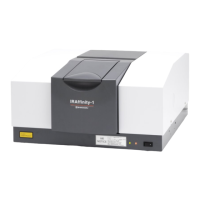
IRAffinity-1
This instrument complies with European standard EN61326-1:1997+amendment 1998.
1. Electromagnetic Emission
This instrument complies with Class B. Class B equipment can be used in all none-industrial environments.
a. Harmonics (IEC61000-3-2:1995)
b. Flicker (IEC61000-3-3:1994)
2. Immunity to Electromagnetic Interferences
This instrument can be used in all none-industrial environments.
Test Conditions:
a. Electrostatic Discharge (IEC61000-4-2:1995/A1:1998)
4 kV (direct/indirect discharge)
b. RF Field Strength Susceptibility (IEC61000-4-3:1996)
3 V/m (Modulation: AM 1 kHz 80%)
c. Surge (IEC61000-4-5:1995)
0.5 kV (Line to line), 1.0 kV (Line to earth)
d. Conducted Susceptibility (IEC61000-4-6:1996)
3 Vrms (0.15 MHz-80 MHz)
e. Power-Frequency Magnetic Field Measurement (IEC61000-4-8:1993)
Field Strength: 30 A/m.
f. Voltage dips, short interruptions and Voltage variations immunity.
To avoid electromagnetic disturbance, follow these two recommended precautions:
1. Before handling the instrument, discharge any electrostatic charge to a grounded object.
2. Do not install the FTIR near strong electromagnetic fields.
NOTE
This section only applies to the EU (European Union) market models 206-72400-34.
NOTE
Increase the distance between the FTIR and other equipment to eliminate electromagnetic disturbances.
NOTE
Compliance with this standard does not imply that the instrument will operate at higher levels of
electromagnetic interference than tested. A greater interference than specified may cause instrument
malfunction.
3.8 Electromagnetic Compatibility





 To Next Page