Chapter 10 - Quality index compatibility between BC-600-PB and BC-700-PB
Copyright 2016 Softing Industrial Automation GmbH
49
10
Quality index compatibility between BC-600-PB and BC-700-PB
10.1 What does the quality index indicate and how is the index determined?
The signal quality index of BC-600-PB or BC-700-PB does not represent a physical measure such as
voltage (volt) or current (ampere). The signal quality index combines various criteria in an index value
and assesses the quality of the PROFIBUS station´s signal. Figuratively speaking, the quality index value
corresponds to the height of a free rectangular area below the signal sequence of a transmitted bit
value ("free" is to say: the signal does not strike the rectangle). The signal sequence corresponding to
3/8 of the bit time at the rising or falling edge are not considered. That is why an ideal, rectangular
signal sequence corresponds to a very high signal quality index, whereas voltage undershoot, spikes
and shallow edges will reduce the tested signal quality index, because the unaffected rectangular area
below the signal sequence is reduced. Bad signal quality values are either caused by a low RS-485 signal
level of tested stations or by disturbances of the signal sequence. Particularly when assessing
disturbances, the bandwidth of your measuring channel has a major influence on the test result. The
measuring channel is composed by the connecting cable and the analogue electronic circuit in the test
device.
10.2 Why might the BC-700-PB display different quality indexes?
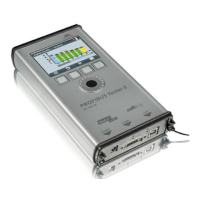
The BC-700-PB uses the same algorithm for computing the signal quality index as it was already used by
PB-T2, PB-T3 and BC-600-PB (PROFIBUS Tester 4). In contrast to the previously named older test
devices, the BC-700-PB comprises a measuring channel with a significantly higher input bandwidth. This
measurement channel is both used for testing the signal quality index and for recording the
oscilloscope signal sequence. That is why BC-700-PB accounts for high-frequency disturbances during
signal quality testing. The test results of other test devices will not account for high-frequency
disturbances, although these type of disturbances play a major role with respect to the functioning of
PROFIBUS networks.
BC-700-PB takes advantage by using the same analog measuring channel for all test functions: Signal
quality index, Signal-to-Noise ratio (S/N) and oscilloscope are based on the same measurement and
therefore are more consistent. You can analyze the cause of a reduced S/N by means of the
oscilloscope function. Additionally, using only one measurement channel reduces the capacitive load on
the network under test and the power consumption is lower. Hence the battery lasts longer.
PROFIBUS networks, which are affected by high-frequency disturbances will show lower quality index
values. In fact the lower signal quality index values represent reality, but the test results will prevent
comparability to former test data, which you have generated using older test devices. If comparability
of test data is a mandatory requirement, it is recommended conducting the comparative test by means
of BC-600-PB.


 To Next Page