24
4.6.7 External protective conductor
The inverter’s stray current to earth can reach values of more than 3.5mA (AC) or 10mA
(DC) during operation. In accordance with IEC/EN 62109-1, a second protective conductor
must therefore be connected. This can be connected to one of the two M6 threaded con-
nections (see Section 4.6).
Connecting conditions
Minimum conductor cross-section: 10 mm²
M6 screw tightening torque: 10.0 Nm
4.6.8 External residual-current device (RCD)
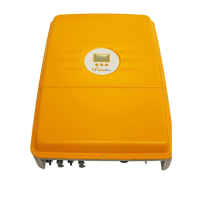
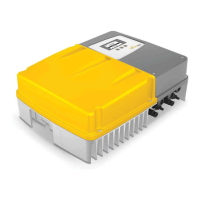
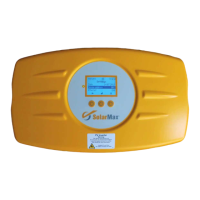
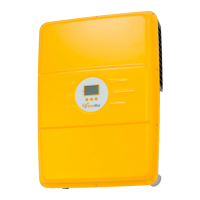
The SolarMax MT series inverters have an integrated AC/DC sensitive fault current
sensor. This sensor is able to distinguish between the operational capacitive stray cur-
rents (caused by capacities of the PV modules to the earth) and fault currents (caused by
touching a pole of the PV generator). The inverter disconnects immediately from the grid
as soon as an exceedance of the absolute limit value (300 mA, important in relation to re
protection) or a sudden increase in the DC-end fault current (30 mA, important to protect
against personal injury) has been detected.
If an additional external residual current device (RCD) is wanted, an RCD of type A should
be chosen. The residual current rating of the RCD depends on the number of inverters in
the PV power plant. For each inverter, a residual current rating of at least 100 mA should
be allowed for. For example, in a PV power plant with three inverters an RCD with a
residual current rating of at least 300 mA should be used.
4.6.9 External output control
The MaxWebxp data logger and its MaxRemote extension can be used to set the set
values for active and reactive power (e.g. for remote controlled output limitation). The
MaxWeb xp is connected via the Ethernet or via the inverter’s RS485 interfaces (see Sec-
tion 4.6.6), i.e. via a MaxComm network.
You can download the installation instructions for the MaxWebxp and MaxRe-
mote accessory components from our website: www.solarmax.com/en/downloads/
data-communication/maxweb-xp.


 To Next Page