2-12
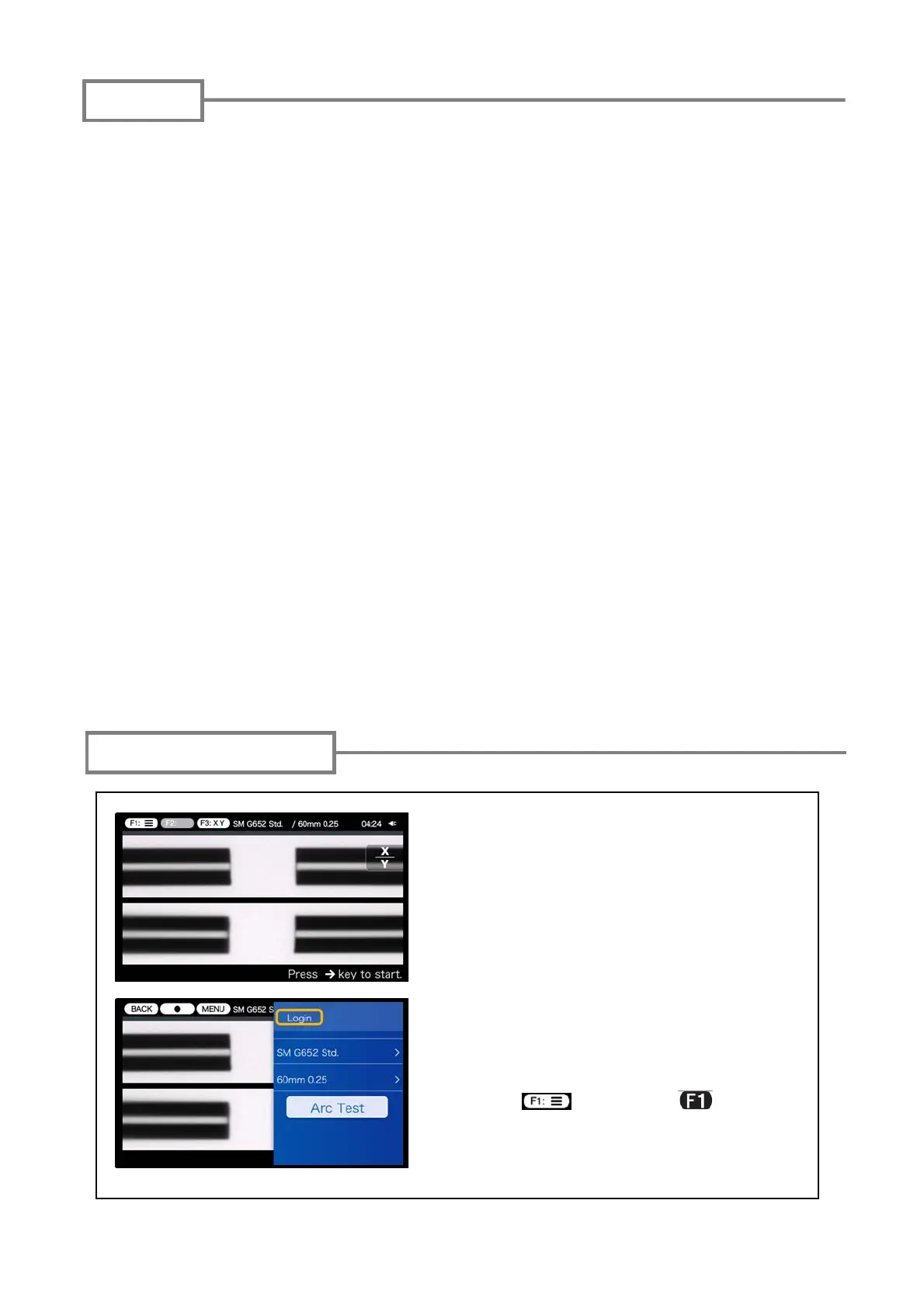
1: Load prepared fiber in the splicer. (The
coating is removed and glass fiber is
cleaved.)
2: In the initial screen, make sure the se-
lected splice/heater programs match the
fiber/protection sleeve being used.
About setting up and changing the pro-
gram, please refer to the page 4-1 and 4-2
“Splice and heater programs setting”.
3: Select
icon (press key) to
open the setup pane.
Fusion splicing is a method of melting and connecting the point of the optical
fiber by heat of electrical discharge. Because optimum arc conditions are
different depending on the environments (atmospheric pressure and tem-
perature) and the electrode conditions (wear-out and adhesion of the glass)
and the optical fibers (manufacturer and SMF/MMF, etc.), appropriate arc
condition is necessary to make a low splice loss. Please perform an arc test
before splicing in the typical splice program such as “SMF Standard”.
In Auto mode, the T-400S has the function to analyze an arc and then cali-
brate the arc condition automatically at each splice. Therefore, an arc test is
not needed usually in Auto mode.
As an exception, perform an arc test in the following situations to cal-
ibrate the arc power and position.
•Poor splice performance
(high or inconsistent splice losses, poor splice strength)
•After electrode replacement
•Extreme changes in temperatures, humidity or air pressure
Arc test procedure
Arc test


 To Next Page