Maintenance, Service, and Repair
Brakes
Page 10
REPLACE FRONT DISC BRAKE PADS
Current Taylor-Dunn
®
brakes are asbestos
free. However, there is the possibility that
the original brakes were replaced with
aftermarket parts containing asbestos.
Since this possibility exists, all brake parts
should be handled as if they contain
asbestos. Refer to Appendix C for
recommended handling precautions.
NOTE: Front brakes are optional. It is recommended
that both the left and right brake pads be
replaced as a set.
NOTE: Installing new brake pads will raise the brake
fluid level in the master cylinder.
1. Make sure the key-switch is in the “OFF”
position, then remove the key.
2. Place the forward-reverse switch in the
center “OFF” position.
3. Confirm the electric park brake is set.
4. Place blocks under the front wheels to
prevent vehicle movement.
5. Disconnect the main positive and
negative cables at the batteries.
6. Thoroughly clean the area around the master
cylinder cap.
7. Remove fluid from the master cylinder until it is 1/
2 full.
8. Raise the front of the vehicle and support with
jack stands.
9. Remove the tire/wheel assembly. Refer to Tires
and Wheels section for information on removing
the tire and wheel assembly.
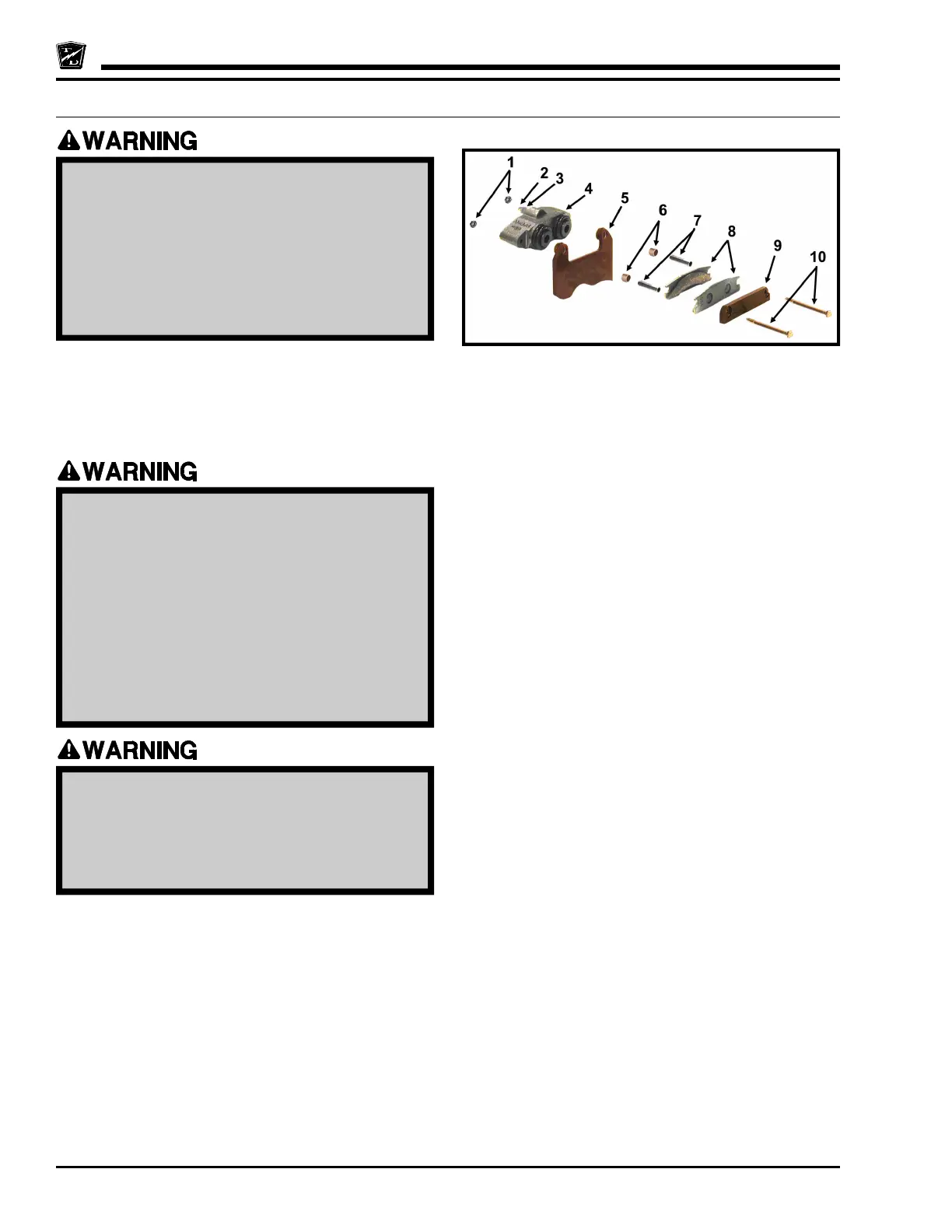
NOTE: Refer to the illustration above for the following
steps.
10. Remove the brake body bolts (10) and discard the
lock nuts (1) and brake pads (8).
11. Remove the spacer bushings (6) from the
mounting bracket (5) and discard the bushings.
12. Inspect the brake rotor. See Inspect the Service
Brakes section for information regarding
inspecting the brake rotor.
13. Inspect the spacers (7) and replace if any wear or
damage is found.
14. Install new spacer bushings in the mounting
bracket.
15. Install new brake pads in reverse order. Torque
the mounting bolts to 11 ft-lbs.
16. Repeat this procedure for the other wheel.
17. Install the tire/wheel assembly and lower the
vehicle to the ground.
18. Fill the master cylinder to the proper level. Refer
to Check Master Cylinder Fluid section for
information on the proper master cylinder fluid
level.
19. Reconnect the main positive and negative cables
at the batteries.
20. Remove the blocks from behind the wheels.
21. Release the park brake and test drive the vehicle.
Always use a lifting strap, hoist, and jack
stands, of adequate capacity to lift and
support the vehicle. Failure to use lifting
and support devices of rated load capacity
may result in severe bodily injury.






 To Next Page