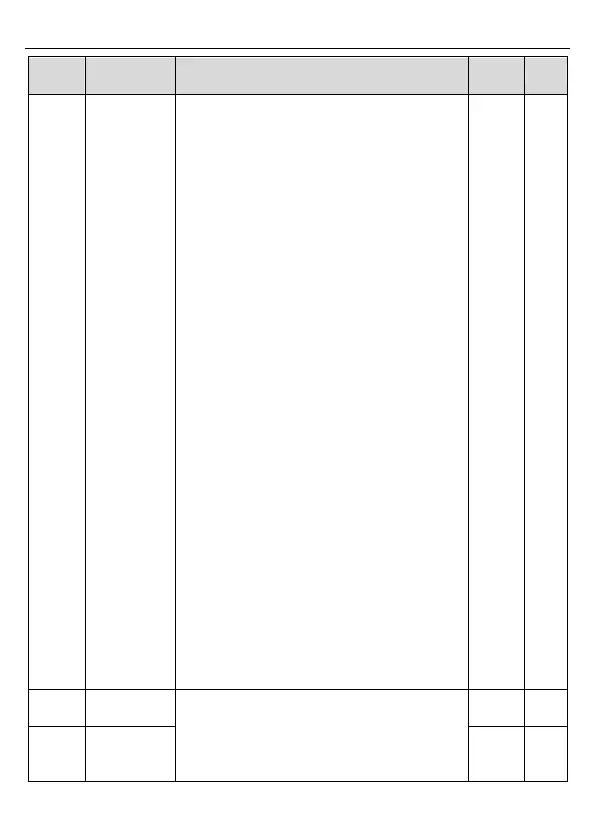
synchronous rotational speed)
4: Output current (relative to twice the rated
inverter current)
5: Output current (relative to twice the rated
motor current)
6: Output voltage (relative to 1.5 times the rated
inverter voltage)
7: Output power (relative to twice the rated motor
power)
8: Set torque value (relative to twice the rated
motor torque)
9: Output torque (relative to twice the rated motor
torque)
10: Analog AI1 input value
11: Analog AI2 input value
12: Analog AI3 input value
13: High-speed pulse HDIA input value
14: Value 1 set through Modbus communication
15: Value 2 set through Modbus communication
16–21: Reserved
22: Torque current (relative to 3 times the rated
motor current)
23: Ramp reference frequency
24: Set frequency (bipolar)
25: Ramp reference frequency (bipolar)
26: Running speed (bipolar)
27: Value 2 set through EtherCAT/PROFINET
communication
28: C_AO1 from PLC (P27.00 must be 1.)
29: C_AO2 from PLC (P27.00 must be 1.)
30: Running speed (relative to twice the motor
synchronous rotational speed)
31–47: Reserved variable
The above function codes define the relative
relation between the output value and analog
output. When the output value exceeds the
range of set maximum or minimum output, it will
count according to the low-limit or upper-limit


 To Next Page