23 MPH200 series video encoders WebUI user manual
Video stream multiplication
Each video encoding prole can be assigned with ve (5) different destina-
tion addresses (primary stream and additional streams). These addresses
can be freely set to unicast, multicast or a combination of these. In addi-
tion there is a tick box that enables to lter out P-frames from each output
stream for low frame rate applications. This approach provides for a very
cost efcient dual streaming in situations where the low frame rate stream
is a direct subset of the higher frame rate stream. In practise this means
that the number of I-frames is the common nominator. As an example, one
MPH241 unit can stream (unicast or multicast) 2 x D1@25fps for monitor-
ing and 4 x 2CIF@3fps (unicast or multicast) for recording simultaneously.
The precondition is, the number of I-frames per second in the primary
stream should match to frame rate of the low frame rate stream. In the
example above the I-frame interval of the primary stream would need to be
8 (GOP = IPPPPPPPIPPPPPPPIPP…) generating 3 I-frames per second
thus resulting in 3fps stream when P-frames are ltered out. The use of
multiple destination addresses up to a certain degree doesn’t load the
MPU; however one should take into account that the aggregate bit rate of
all output streams does not exceed the capacity of the 100Mbps interface.
_________________________________________________________
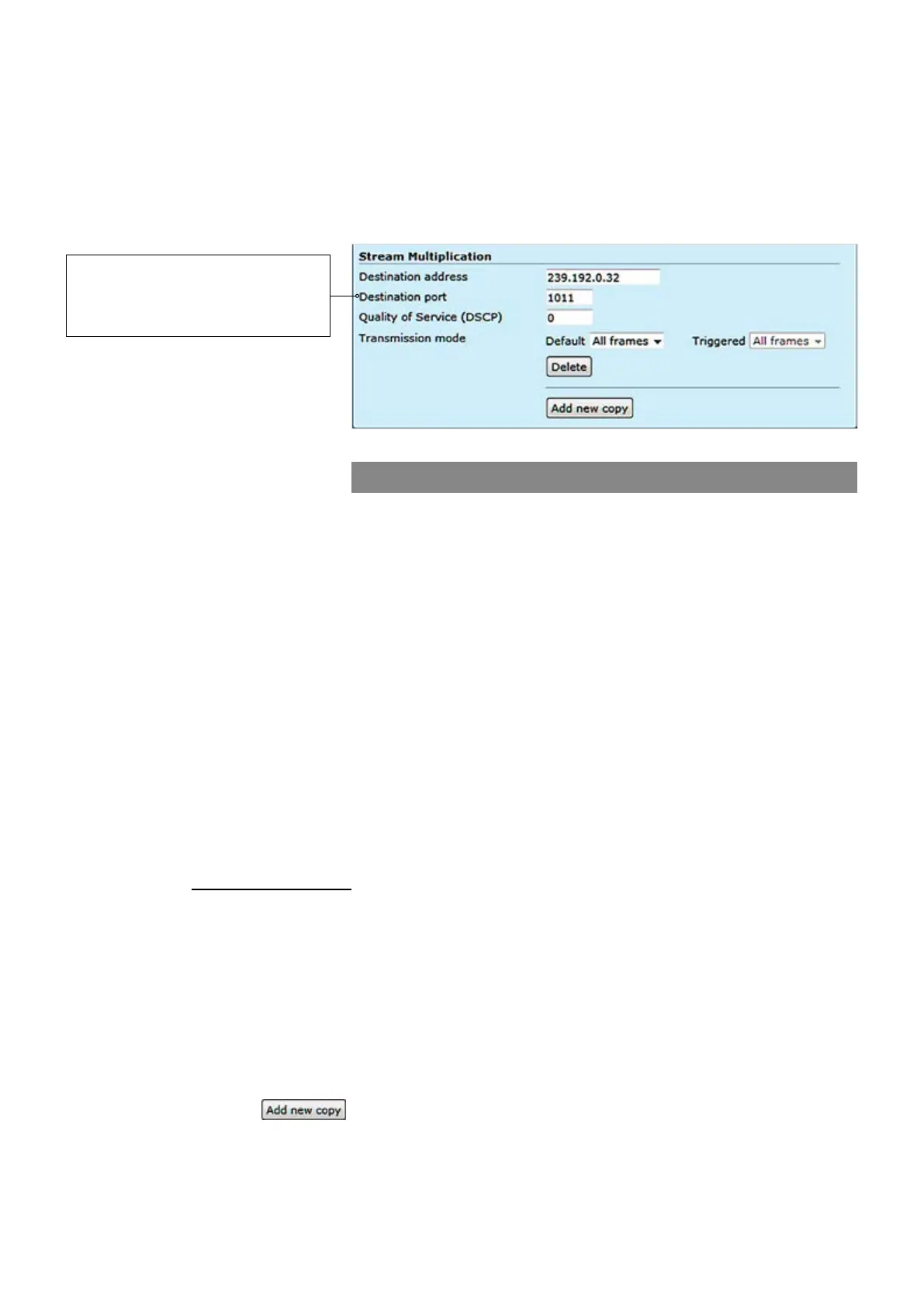
Destination IP address. Multicast: Multicast IP address / multicast group.
This multicast IP address has to be same at both encoder and
corresponding decoders. Unicast: IP address of receiving decoder.
UDP port number (0...65536). This number has to be same at both
encoder and decoder pairs. Use even port numbers only.
Differentiated Services Code Point eld lets you set bits in the stream IP
header allowing a network device to apply rules such as how the packet is
forwarded in the network and QoS (Quality of service) management.
All frames is the default option and enables the encoder to pass (stream)
all frames (I and P frames). I frames enables encoder to send only
I-frames, meaning ltering all P frames. Paused = pause streaming.
Adds new copy from stream.
Stream multiplication:
Destination address:
Destination port:
Quality of Service (DSCP/DiffServ ):
Transmission mode:
:
Note! Only even port numbers can
be used for RTP, and then the
following odd port number shall be
used for RTCP (RFC 1889).
(Differentiated Services Code Point) eld lets you set bits in the stream IP
header allowing a network device to apply rules such as how the packet is
forwarded in the network and QoS (Quality of service) management.
All frames is the default option and enables the encoder to pass (stream)
all frames (I and P frames). I frames enables encoder to send only
I-frames, meaning ltering all P frames. Paused = pause streaming.
RTP (Real-time Transport Protocol), SRTP (Secure Real-time Transport
Protocol) or TS (MPEG transport stream).
Quality of Service (DSCP )(0...63):
Transmission mode:
Container:



 To Next Page