55 MPH200 series video encoders WebUI user manual
Switch inroduction and features
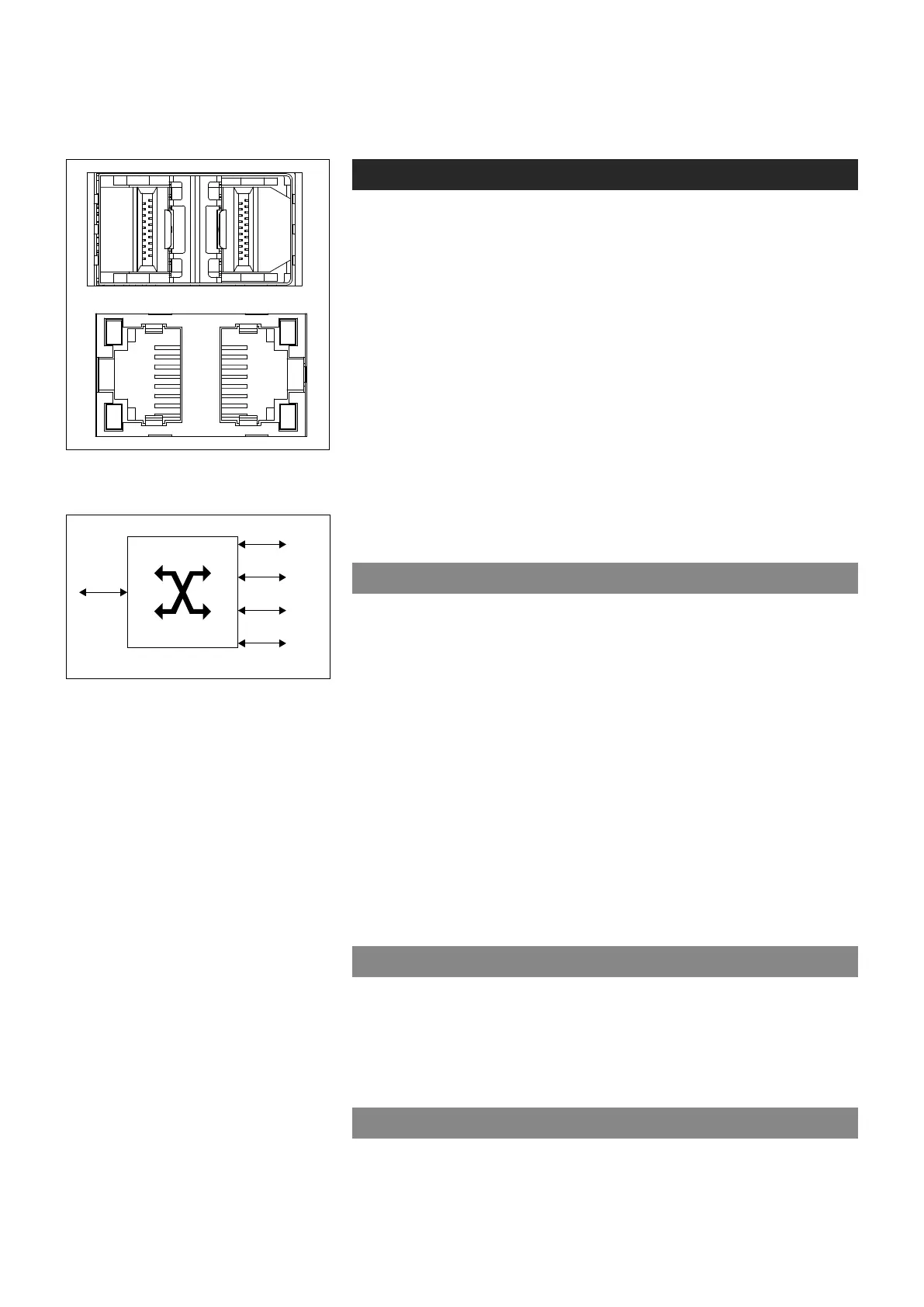
MPH200 has a built-in four port tri-speed Ethernet Switch with two
integrated copper transceivers and two SFP ports. Switch is a fully
managed eld hardened stand-alone Gigabit Ethernet switch for video
networking applications. The product is designed for use in harsh
environment applications.
MPH200 Ethernet Switch provides non-blocking wire-speed perfor-
mance. It can operate as either a VLAN-aware switch or a VLAN-un-
aware switch. It can forward frames at Layer 2, based on information
from layer 2 and layer 3. All memory is included on-chip, because each
port has its own shared memory of 20 kilobytes for frame storage. This
section gives an overview of the functionality and features of the switch.
MPH200 Ethernet Switch supports IGMP snooping, VLAN, network
redundancy, SNMP management, port conguration, port alarms, QoS
(layer 2 and 3) and port mirroring. Switch supports both command line
interface (CLI) and WEB User Iinterface (WebUI).
Auto-negotiation
MPH200 Ethernet Switch supports twisted pair auto-negotiation, as
dened in IEEE Std 802.3-2002 clause 28. The purpose of auto negotia-
tion is to allow a device to advertise modes of operation. The auto
negotiation function provides the means to exchange information between
two devices that share a point-to-point link segment, and to automatically
congure both devices to take maximum advantage of their abilities. Auto
negotiation is performed totally within the physical layers during link
initiation, without any additional overhead to either the MAC or higher
protocol layers. Auto negotiation allows the ports to do the following:
• Advertise their abilities
• Acknowledge receipt and understanding of the common modes of
operation that both devices share
• Reject the use of operational modes that are not shared by
both devices
• Congure each port for the highest-level operational mode that both
ports can support.
Auto MDI/MDI-X function
The device automatically detects whether the cable connected to an
RJ-45 port is crossed or straight through, when auto-negotiation is
enabled. Standard wiring for end stations is Media-Dependent Interface
(MDI) and the standard wiring for hubs and switches is known as
Media-Dependent Interface with Crossover (MDIX).
QoS – quality of service
Various classications and prioritizations are supported in order to
enable Quality of Service for real time applications. The switch supports
four QoS classes. On each port, an enhanced categorizer assigns
priorities based on information taken from Layer 2 and Layer 3.
MPH200 has two xed (3 &4) and two
SFP (1 & 2) Ethernet ports.
MPH200 switch’s internal connection.
Conguring ethernet switch
Encoder
Port 2 (SFP)
Port 3 (RJ-45)
Port 4 (RJ-45)



 To Next Page