ISOCAN / ISOBUS ARTEMIS - SEED DRILL CONTROLLER
14
3 Motor Control Module and Sensors
NOTE: For multi-channel installations, ensure the Seed Shaft Confirmation sensor(s), Hopper Level sensor(s) and Priming switch
are connected to the appropriate Expansion Harness.
3.1 MCM mounting
The MCM modules are sealed and it is not essential to mount them inside another enclosure for protection against the
elements. However, a box-type cover or enclosure will offer more protection from pressure washing or physical
damage, and make the installation look neater.
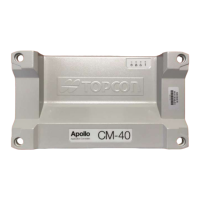
The MCM modules [45] should if possible be grouped centrally, mounting them on a single mounting plate that is
grounded to the chassis via a central ‘Master Grounding point’ (fig.14). observing that,
the sticker is facing out and cable connection points are at the bottom.
the motor drive wires can be easily connected onto the module,
the motor encoder cable can connect onto connector ‘A’ of the Expansion Harness S/TC/1015540-01.
Mount them using the M5 Set Screws [21], Flat Washer [22] and Nut [23].
MAKE THE CONNECTIONS ONTO THE STUDS WITH FLAT WASHERS EITHER SIDE OF THE TERMINAL(S) AND M5 NUT.
Ensure all connections are tight and that there is no possibility of them shorting together. It is advisable to coat the
studs with petroleum jelly or an equivalent.
NOTE: The motors direction of rotation will be dependant upon which way it is connected to the MCM. If the direction of rotation
is incorrect simply reverse the connections.
The yellow/green wire fitted to the motor should be connected onto the grounding point (ref. Section 3.3).
3.2 Power Supply
Route the Tractor Power Cable [13] direct from the battery to the rear of the tractor (or to the front for a front-
mounted hopper).
Route the Implement Power Cable [24] to a point central to the MCM modules. Mount the Fuseholder [28]. Cut the
red wire to length and connect to the fuseholder using terminal [29].
3.3 Motor and MCM 0V connection and Grounding
NOTE: Fan operation particularly in dry conditions, can generate extremely high-voltage static charge. Therefore, it is
ESSENTIAL to install the Yellow/Green ground wiring and Black 0V wiring as instructed, to help protect the system
against electro-static discharge (ESD).
Providing modules are located in close proximity to each other (e.g. less than 500mm), then the Module 0V wires [25]
and Motor earth wires can be connected directly to a ‘Master Grounding point’ (ref. figure 14).
If the modules are NOT located in close proximity to each other (e.g. MORE than 500mm), then the Module 0V wires
[25] are still connected to the ‘Master Grounding point’, however, you MUST ALSO establish a reliable chassis grounding
point locally next to each Module.
The Motor earth wire is then connected to the local grounding point, and also a separate Earth Strap [57] must be
connected between the local grounding point and the 0V stud on the adjacent Module (ref. Figure 15).
Establish a reliable ‘Master Grounding point” on the chassis using M5 Set Screw, Washers and Nut [21,22,23], and
connect the master 0V wire using terminal [29]. Using a multimeter, check continuity between the wire terminal and
chassis is acceptable. The grey rectangle in figure 14 suggests a metal mounting plate for the modules but can also be
the chassis of the drill.
Using the black wire [25] and crimps [30] supplied, connect separate 0V wires between the ‘Master Grounding point’
and the 0V stud on each module.
Using the red wire [26] and crimps [30] supplied, connect separate +V wires between the Fuseholder [28] and the +V
stud on each module.



 To Next Page