WP1624
Firewood Processor
Safety
12
Safety
2.6.7 Chain Saw Safety
A chain saw is inherently hazardous. Potential injuries can be
minimized by using proper personal protective equipment and
safe operating procedures.
Good cutting action results and chain life increases with correct
chain tension. If too loose, a chain can derail; if too tight a chain
can bind.
Proper chain lubrication prolongs the life of the saw and
increases safety.
Sharpen the saw if:
• The chain tends to track sideways while cutting.
• The cut shows fine powder instead of chips.
• There is a burnt wood smell.
Never use a saw chain that:
• Has broken twice.
• Is severely damaged.
• Has excessive saw chain stretch.
• Has broken or cracked components.
• Has loose rivet joints. If you can rotate the rivets with
your fingers, they are too loose.
2.6.8 Battery Safety
• Wear gloves and safety glasses or face shield when
working on or near batteries.
• Use a battery carrier to lift the battery or place hands at
opposite corners to avoid spilling acid through the vents.
• Avoid contact with battery electrolyte:
• External Contact: Flush immediately with water.
• Eye Contact: Flush with water for 15 minutes. Get
prompt medical attention. Clean up any spilled
electrolyte immediately.
• Avoid contact with battery posts, terminals and related
accessories. They contain lead and lead compounds,
chemicals known to cause harm. Wash hands immediately
after handling.
• Keep all sparks and flames away from batteries. Gases
given off by electrolyte is explosive.
• To avoid injury from spark or short circuit, disconnect
battery ground cable before servicing any part of the
electrical system.
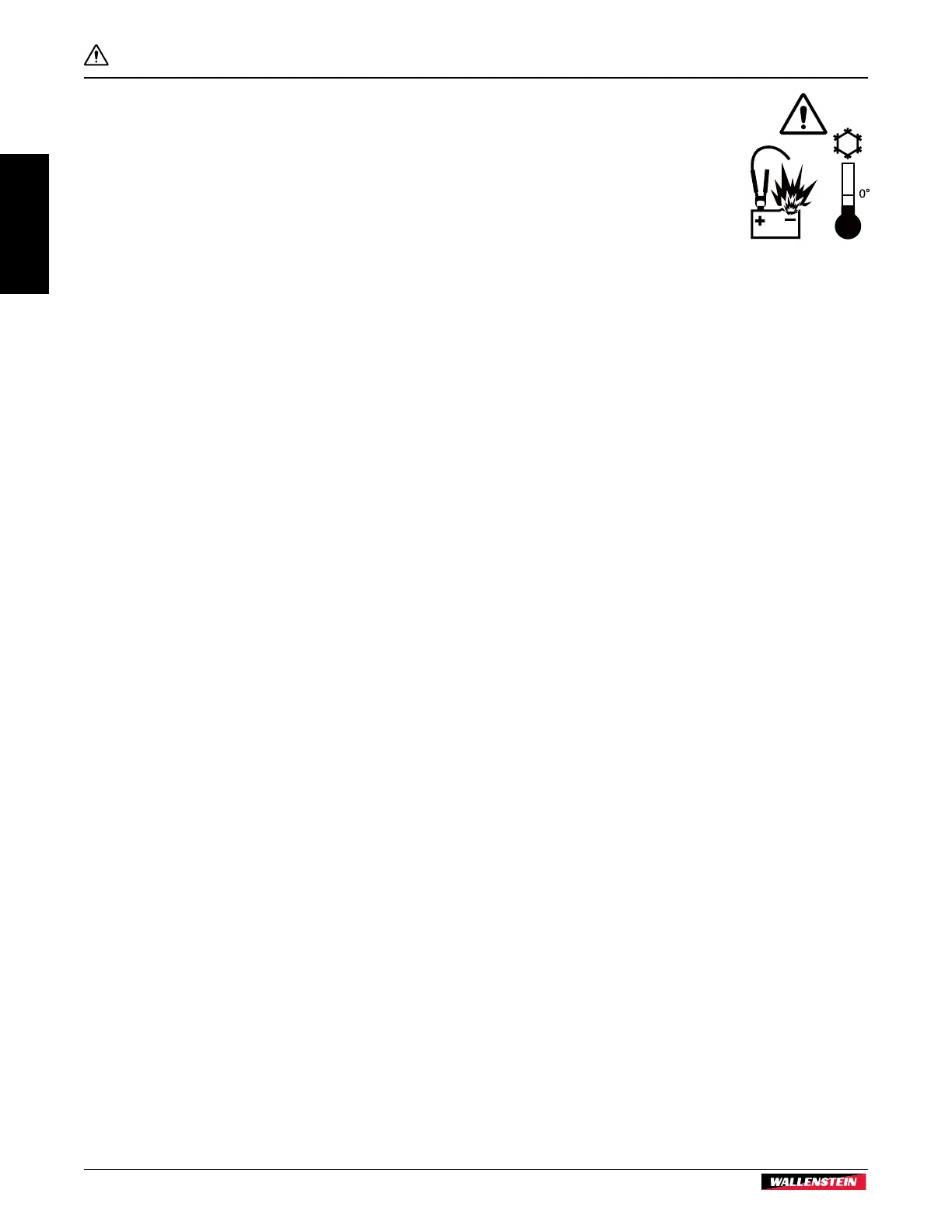
• Frozen batteries can explode and
result in death or serious injury. Do not
jump start or charge a frozen battery.
Let battery thaw before charging.
2.6.9 Gas Engine Safety
• DO NOT operate engine in an enclosed area. Exhaust gases
contain carbon monoxide, which is an odorless and deadly
gas.
• DO NOT place hands or feet near moving or rotating parts.
• DO NOT choke carburetor to stop engine. Whenever
possible, gradually reduce engine speed before stopping.
• DO NOT tamper with governor springs, governor links
or other parts which may increase the governed speed.
Engine speed is selected by the original equipment
manufacturer.
• DO NOT check for spark with spark plug or spark plug wire
removed.
• DO NOT crank engine with spark plug removed. If engine is
flooded, crank until engine starts.
• DO NOT strike flywheel with a hard object or metal tool as
this may cause flywheel to shatter in operation. Use proper
tools to service engine.
• DO NOT operate engine without a muffler or heat shield.
Inspect periodically and replace if damaged.
• DO NOT operate engine with an accumulation of wood
chips, dirt or other combustible materials in the muffler
area.
• DO NOT use this engine on any forest covered, brush
covered, or grass covered unimproved land unless a spark
arrester is installed on the muffler. The arrester must be
maintained in effective working order by the operator. In
the state of California the above is required by law (Section
4442 of the California Public Resources Code). Other states
may have similar laws. Federal laws apply on federal land.
• DO NOT touch hot muffler, cylinder or fins. Contact may
cause burns.
• DO NOT run engine with air cleaner or air cleaner cover
removed. Engine damage can result.


 To Next Page