Electrical safety testing
Welch Allyn recommends performing ground continuity, leakage current, and dielectric strength
tests
1
when replacing the power supply or primary wiring according to EN/IEC 60601-1 - Medical
Electrical Equipment – Part 1: General Requirements for Basic Safety and Essential Performance or
EN/IEC 62353 - Medical Electrical Equipment - Recurrent Test and Test After Repair of Medical
Electrical Equipment.
Due to the variability of test equipment in the field, Welch Allyn does not include specific
instructions to perform electrical safety tests. When performing electrical safety tests, refer to
your test equipment manuals for detailed instruction. The following table provides connections and
test limits to assist you in performing these tests.
Test Limits
Ground continuity Ground continuity from EP stud* (equipotential terminal) to the Gnd pin
of the IEC power connector shall be no greater than 0.1 ohms.
Leakage current Leakage current shall be less than 300 µA from EP stud* to mains (Line
and Neutral pins of the IEC power connector).
Dielectric strength Dielectric strength shall be 1.8 kVAC EP stud* to IEC mains (Line and
Neutral pins of the IEC power connector).
* To locate the equipotential terminal, see “Controls, indicators, and connectors.”
Ground stud connector
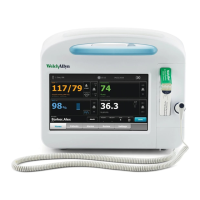
VSM 6000 Series devices are equipped with a ground stud (equipotential terminal) for electrical
safety testing, and to connect a potential equalization conductor. To ensure use of the proper
connector for safety testing, the ground stud is recessed into the monitor’s housing. Do not use
“alligator” style clamps and connectors. The mating electrical connector requires self assembly by
crimping it to appropriate connecting leads.
The mating connector (Type POAG-KBT6DIN, order number 15.0010) consists of the right-angled
socket and insulator, as shown in the next figure. You can purchase the mating connector and the
crimping pliers from the manufacturer, Multi-Contact (http://www.multi-contact.com).
1
Perform this test only if there is a reason to doubt the integrity of the electrical insulation (e.g. multiple trips of a
residual-current device or liquid ingress of a saline solution). If you determine this test should be performed, return
the device to Welch Allyn for service.
87


 To Next Page
 Loading...