Operation0820−1/A1
Winterthur Gas & Diesel Ltd.
4/ 7
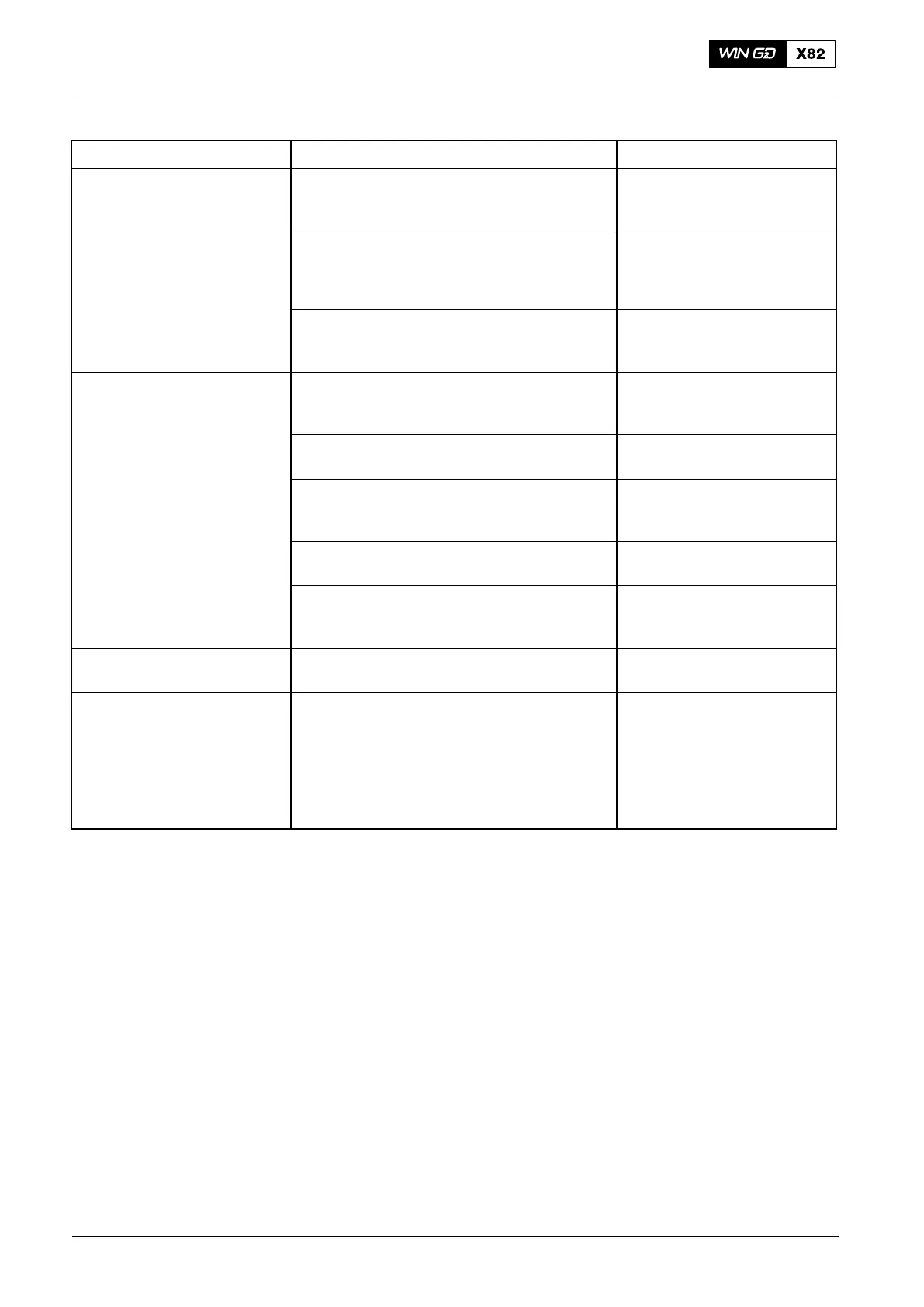
Problem Possible Causes Procedure
Irregular operation of the
cylinder cooling water system
Air collects in the cooling spaces or in the
pipes because pressure release is not
sufficient.
Release the pressure.
Pressure increases and
decreases quickly
There is a decrease of static pressure at the
inlet to the cooling water pump because of a
blockage in the return pipe or the expansion
tank has drained.
See the plant instructions.
The exhaust gases go into the cooling water
because of a crack in the cylinder liner,
cylinder cover, valve cage.
See 0545−1 Operation with
Water Leakage into the
Combustion Chamber.
Increased cooling water
temperature at the outlet of a
cylinder
The shut-off valves in the pipes of the related
cylinders were accidentally closed, or
defective.
Open the shut-off valves or
replace them.
The pressure in the cooling spaces is not
sufficiently released.
Release the pressure.
The cooling water pipes or water channels
are blocked. The water flow is not sufficient.
See Cooling 0760−1 Cooling
Water / Cooling Water
Treatment.
The piston is too hot. See 0840−1 Problems and
Damage with Engine Parts.
The exhaust gases go into the cooling water
because of a crack (cylinder liner, cylinder
cover, valve cage).
See 0545−1 Operation with
Water Leakage into the
Combustion Chamber.
Increased cooling water
temperature on all cylinders
Plant side is defective (regulating valve,
cooling water cooler etc.)
See plant instructions.
Crosshead bearing oil
pressure decreases to main
bearing oil pressure
Crosshead bearing oil pump is defective. Oil
flows through the non-return valve from main
bearing oil system.
Decrease the engine load to
40%.
Repair the crosshead bearing
oil pump as soon as possible.
Until then, increase the main
bearing oil pressure as much
as possible.
2. Cylinder Lubrication
If the cylinder lubrication does not operate correctly, the piston rings and cylinder
liners will wear quickly. Also, the piston can seize. Only in emergencies, and then at
decreased power and only for the minimum possible time, can an engine operate
without cylinder lubrication.
Faults in the cylinder lubricating system cause related messages in the WECS–9520,
which are sent to the alarm and monitoring system.
Also, the LED on the ALM−20 come on to show the related faults (see also 0850−1
Malfunction of cylinder lubrication and 7218−1 LED indications).
2014
Irregular Operation


 To Next Page