Operation
5556−1/A1
Winterthur Gas & Diesel Ltd.
1/ 3
Fuel Pump
1. General
Four fuel pumps (6-cylinder to 8-cylinder engines) or six fuel pumps (9-cylinder
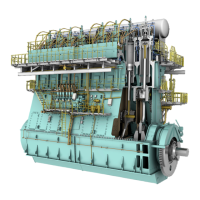
engines) are installed on the fuel pump unit (see Fig. 1 and 5581−1 Fuel Pump Unit).
The fuel pumps (1) supply high pressure fuel through the HP fuel pipes to the fuel rail.
The fuel pumps (1) are controlled to supply as much fuel to keep the necessary
pressure (which is load related) in the fuel rail.
A toothed rack is connected to the fuel pump actuator (2). For more data, see 5583−1
Fuel Pump Actuator.
016.859/08
1
2
DATA SHOWN FOR
6-CYLINDERS TO
8-CYLINDERS
FUEL SIDE
Fig. 1: Location of Fuel Pumps
1 Fuel pump 2 Fuel pump Actuator
2. Function
The compression spring (8, Fig. 2) keeps the lower spring carrier (10) against the
guide piston (9), which in turn keeps the roller (11) against the cam (13). When the
cam (13) moves the roller (11) up, the guide piston (9) moves up and the lower spring
carrier (10) compresses the compression spring (8). The pump plunger (15) then
moves up. The control grooves (20, Fig. 3) in the pump plunger (15) control the
necessary fuel quantity.
When the toothed rack (6) moves, the teeth engage with the teeth on the regulating
sleeve (5) and the regulating sleeve turns. The regulating sleeve (5) turns the
driver (PD) and thus the pump plunger (15).
When the pump plunger passes BDC, fuel flows through the two inlet bores (21,see
Fig 3) and the two control grooves (20) into the plunger chamber (19). The quantity of
fuel that enters the plunger chamber (19) is related to the control position (between 0
for zero supply and 10 for maximum supply).
Note: No fuel is supplied when the inlet bores (21) overlap the control
grooves (20) in position 0 (zero).
2014


 To Next Page