2-13
Installation Information CT Hoods and DD Ventilation
TO REDUCE THE RISK OF FIRE, USE ONLY METAL DUCTWORK.
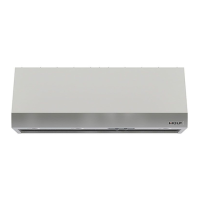
CTE WALL HOOD INSTALLATION CONSIDERATIONS
TO REDUCE THE RISK OF FIRE AND ELECTRIC SHOCK, THIS VENTILATION HOOD SHOULD ONLY BE
INSTALLED WITH BLOWERS MANUFACTURED BY WOLF APPLIANCE INC. AND SPECIFIED FOR USE WITH
THESE VENTILATION MODELS.
INSTALLATION OPTIONS:
Ducted Installation. 1.
In a ducted installation, the hood aspirates the kitchen air saturated with fumes and odors, passes it through the
grease fi lter(s) and expels it to the outside through ductwork.
For this installation, a hood with an internal,
in-line or remote blower can be used. In-line blowers are located in ductwork between the hood and the outside.
For wall hoods, the remote blower can be mounted on the roof or an exterior wall. Wolf in-line and remote blower
assemblies are available through your Wolf dealer.
Recirculating Installation.2.
In a recirculating installation, the hood aspirates the kitchen air saturated with fumes and odors, purifi es it through
the grease fi lter(s) and charcoal fi lter and returns clean air into the room. For constant effi ciency, the charcoal fi lter
must be replaced periodically. For this installation, a recirculation kit available through your Wolf dealer will be
required.
NOTE: For Installation instructions for Recirculating Option please see Installation Manual that was provided with
the product.
LOW-PROFILE HOOD INSTALLATION SPECIFICATIONS AND PREPARATIONS
Decide where the ductwork will run between the hood and the outside. A straight, short duct run will allow the hood
to perform more effi ciently. Limit the number of elbows and transitions to as few as possible. Long duct runs, elbows
and transitions will reduce the performance of the hood. Wolf recommends the maximum linear duct run be no greater
than 50’ (15 m).
NOTE: There is a possibility of noise issues, if a short duct run is coupled with a remote blower.
Wolf recommends installing a backdraft damper in all installations. A backdraft damper is included with the hood. It is
built into the transition from the hood to the duct run. Unless you are using a remote blower, a roof or wall cap should
be installed. Connect ductwork to the cap and work back towards the hood. Use duct tape to seal the ductwork joints.
NOTE: Local building codes may require the use of make-up air. Consult a local HVAC professional for specifi c
requirements.
NOTE: Consult a qualifi ed HVAC Engineer for specifi c ducting applications.


 To Next Page