Clean the programmer as needed by wiping o the outer surface using a moist cloth and a small amount of
mild soap. Do not submerge the programmer in liquids or use a cloth that is saturated. Do not use alcohol,
cleaning soluons, or solvents to clean the programmer.
Maintaining the IPG Baer y
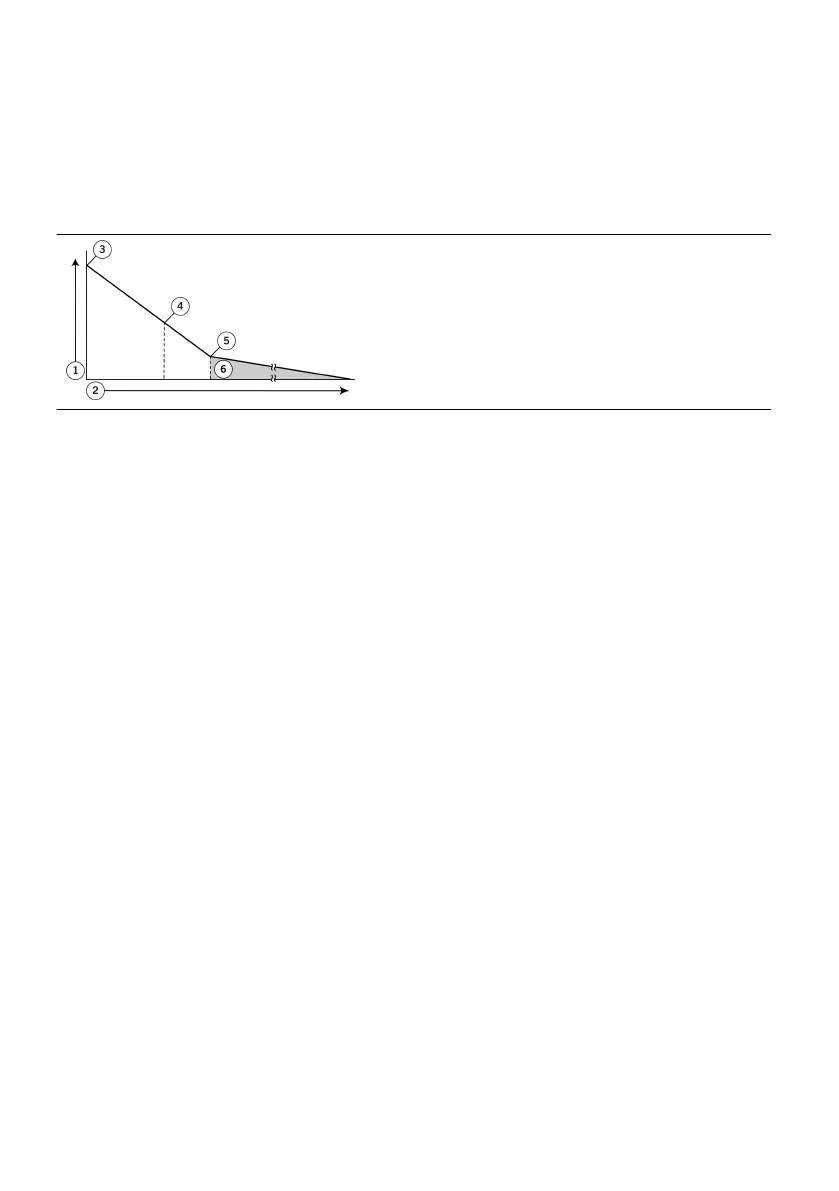
The IPG contains a lithium ion baery. The me it takes to recharge a baery depends on these factors: age of
the baery, daily usage me, smulaon sengs, and length of me since the last recharge. The following
graph shows how the rechargeable baery depletes over me.
Figure 78. IPG baery depleon over me
1. Baery capacity1.
2. Time2.
3. Baery fully charged3.
4. Recharge noce4.
5. Smulaon stops5.
6. Recharge within 30 to 90 days6.
If the paent does not recharge the baery, smulaon will eventually stop, and the paent then must
recharge the baery to prevent baery damage. Aer smulaon stops, a new baery can last up to 90 days
before it must be recharged, while a ten-year-old baery should be recharged within 30 days.
When the IPG is used at high smulaon parameters for tonic programs or at nominal smulaon parameters
for
BurstDR
™ smulaon programs, baery usage studies demonstrate that the baery should allow at least
ten years of praccal recharging. In other words, a ten-year-old device will maintain at least 24 hours of
connuous therapy between recharges.
Depending on the paent’s smulaon parameters, the device will connue to operate for months to years.
Paents may experience a signicantly longer device life before recharging is determined to be impraccal if
they use lower smulaon parameters, a frequent recharging protocol, or both. Frequent recharging can
reduce charging session mes and maximize the IPG’s life.
NOTE: The model used to predict device longevity was generated by ng a mathemacal model to three
years of real-me cycling data, which was then used to extrapolate device baery capacity at the end of ten
years.
Troubleshoong
This secon provides troubleshoong procedures to help you idenfy and solve problems that may occur.
NOTE: Keep funconal backup items on hand. Especially keep the following items available during
intraoperave tesng: trial smulator, trial cable, and fresh baeries.
Troubleshoong Procedure
If a paent programmer or IPG problem is suspected, follow these steps to help solve or isolate the problem:
NOTE: Always set the amplitude to zero before making adjustments; then slowly increase the amplitude to
test the eect of the change.
1. Check the programmer screen for a diagnosc message. If there is one, connue with “Troubleshoong a1.
Diagnosc Message” (page 33) and try the soluon.
2. Verify that the IPG power is on.2.
3. Verify that the amplitude is at the correct level.3.
4. Wait for the programmer power to shut o (approximately one minute).4.
5.
Turn on the programmer again.
5.
6.
Begin smulaon and adjust the amplitude to a comfortable level.
6.
7.
Try the suggested soluon on the appropriate troubleshoong chart: “Troubleshoong Chart for
7.
Intraoperave Tesng” (page 34) or “Troubleshoong Chart for Postoperave Programming” (page 35).
8.
Call Technical Support.
8.
32




 To Next Page