EasyManua.ls Logo

ACT apricot - RS232 C Connector Detail

ACT apricot
328 pages
Print Icon
To Next Page IconTo Next Page
To Previous Page IconTo Previous Page
Loading...
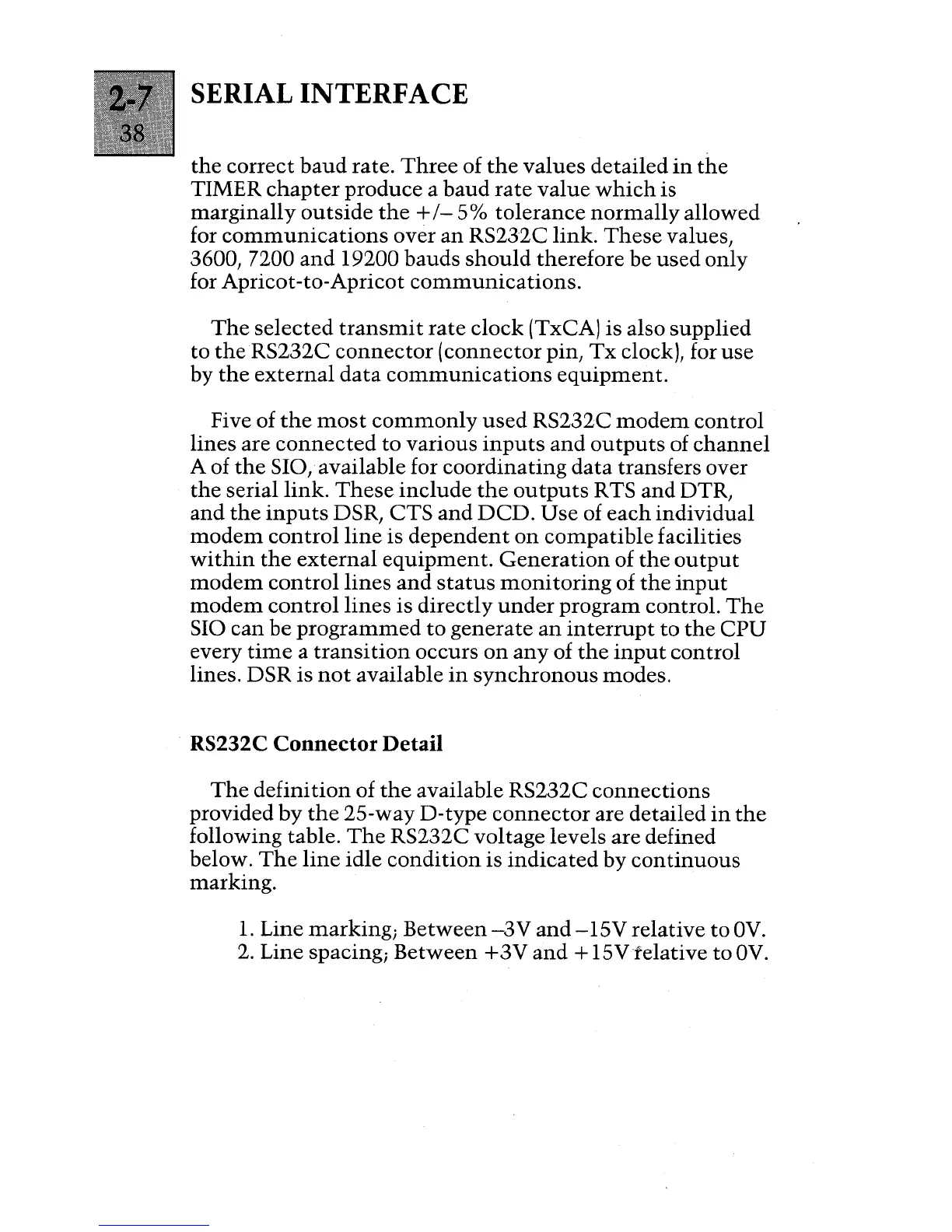
SERIAL INTERFACE
the
correct
baud
rate.
Three
of
the
values
detailed
in
the
TIMER
chapter
produce
a
baud
rate
value
which
is
marginally
outside
the
+/-
5%
tolerance
normally
allowed
for
communications
over
an
RS232C
link.
These
values,
3600, 7200
and
19200
bauds
should
therefore
be
used
only
for
Apricot-to-Apricot
communications.
The
selected
transmit
rate
clock
(TxCA)
is
also
supplied
to
the
RS232C
connector
(connector
pin,
Tx
clock), for
use
by
the
external
data
communications
equipment.
Five of
the
most
commonly
used
RS232C
modem
control
lines
are
connected
to
various
inputs
and
outputs
of
channel
A of
the
SIO/available
for
coordinating
data
transfers
over
the
serial
link.
These
include
the
outputs
RTS
and
DTR,
and
the
inputs
DSR,
CTS
and
DCD.
Use
of
each
individual
modem
control
line
is
dependent
on
compatible
facilities
within
the
external
equipment.
Generation
of
the
output
modem
control
lines
and
status
monitoring
of
the
input
modem
control
lines
is
directly
under
program
control.
The
SIO
can
be
programmed
to
generate
an
interrupt
to
the
CPU
every
time
a
transition
occurs
on
any
of
the
input
control
lines.
DSR
is
not
available
in
synchronous
modes.
RS232C Connector Detail
The
definition
of
the
available
RS232C
connections
provided
by
the
25-way
D-type
connector
are
detailed
in
the
following table.
The
RS232C
voltage
levels
are
defined
below.
The
line
idle
condition
is
indicated
by
continuous
marking.
1.
Line
marking;
Between
-3V
and
-15V
relative
to
OV.
2.
Line
spacing;
Between
+3V
and
+
15Vtelative
to
OV.

Table of Contents

Other manuals for ACT apricot