EasyManua.ls Logo

ACT apricot - General; Screen Ram

ACT apricot
328 pages
Print Icon
To Next Page IconTo Next Page
To Previous Page IconTo Previous Page
Loading...
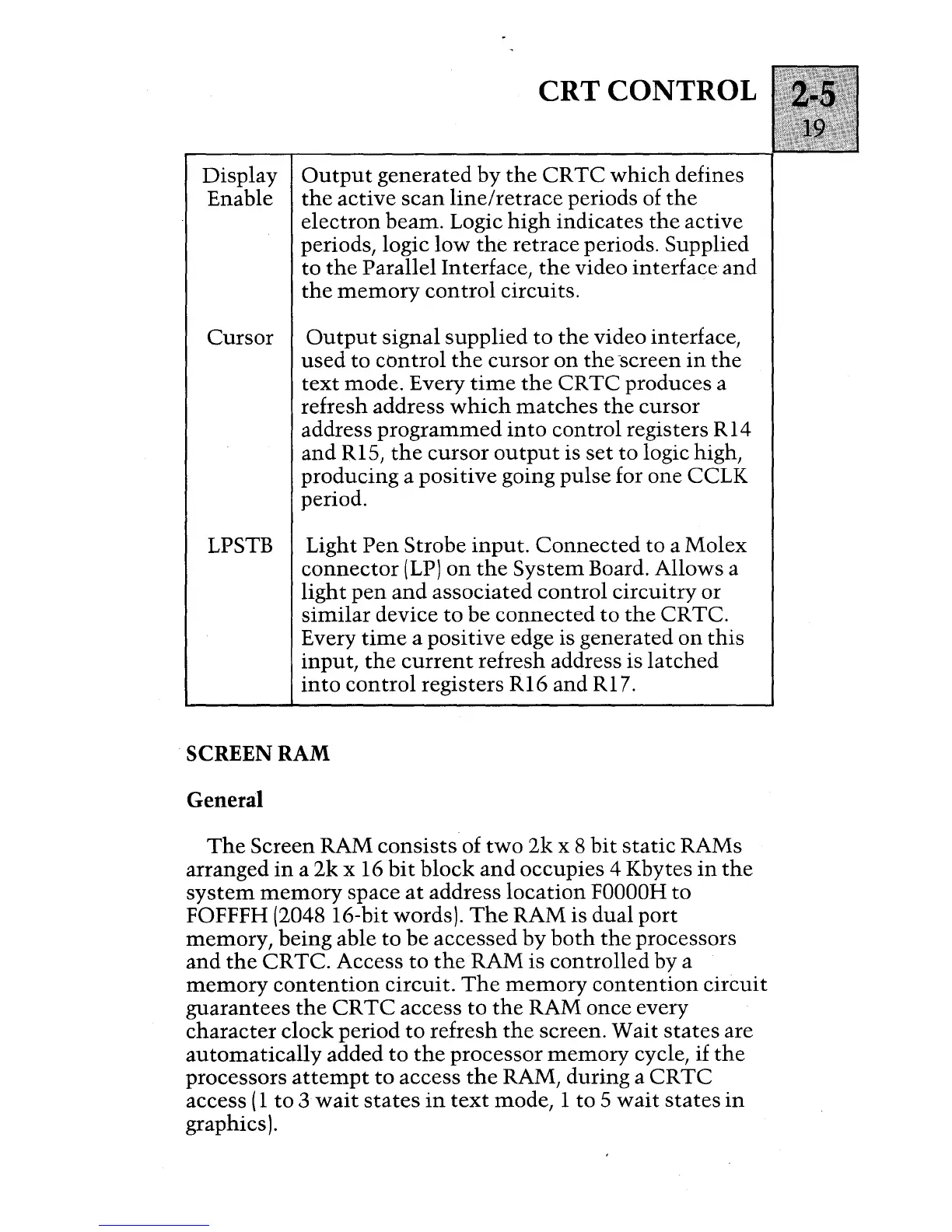
Display
Enable
Cursor
LPSTB
CRT
CONTROL
Output
generated
by
the
CRTC
which
defines
the
active
scan
line/retrace
periods of
the
electron
beam.
Logic
high
indicates
the
active
periods, logic
low
the
retrace
periods. Supplied
to
the
Parallel Interface,
the
video
interface
and
the
memory
control
circuits.
Output
signal
supplied
to
the
video interface,
used
to
control
the
cursor
on
the-screen
in
the
text
mode. Every
time
the
CR
TC
produces a
refresh address
which
matches
the
cursor
address
programmed
into
control
registers R14
and
R1S,
the
cursor
output
is
set
to
logic high,
producing
a
positive
going
pulse
for one CCLK
period.
Light
Pen
Strobe
input.
Connected
to a
Molex
connector
(LP)
on
the
System
Board. Allows a
light
pen
and
associated
control
circuitry
or
similar
device
to
be
connected
to
the
CR
TC.
Every
time
a
positive
edge is generated
on
this
input,
the
current
refresh address
is
latched
into
control
registers R16
and
R17.
SCREEN RAM
General
The
Screen
RAM
consists
of
two
2k
x 8
bit
static
RAMs
arranged
in
a
2k
x 16
bit
block
and
occupies 4 Kbytes
in
the
system
memory
space
at
address
location
FOOOOH
to
FOFFFH (2048 16-bit words).
The
RAM
is dual
port
memory,
being
able
to
be accessed
by
both
the
processors
and
the
CRTC.
Access
to
the
RAM
is
controlled
by a
memory
contention
circuit.
The
memory
contention
circuit
guarantees
the
CRTC
access
to
the
RAM
once
every
character
clock
period
to
refresh
the
screen.
Wait
states
are
automatically
added
to
the
processor
memory
cycle,
if
the
processors
attempt
to
access
the
RAM, during a
CR
TC
access
(1
to
3
wait
states
in
text
mode, 1
to
5
wait
states
in
graphics).

Table of Contents

Other manuals for ACT apricot